
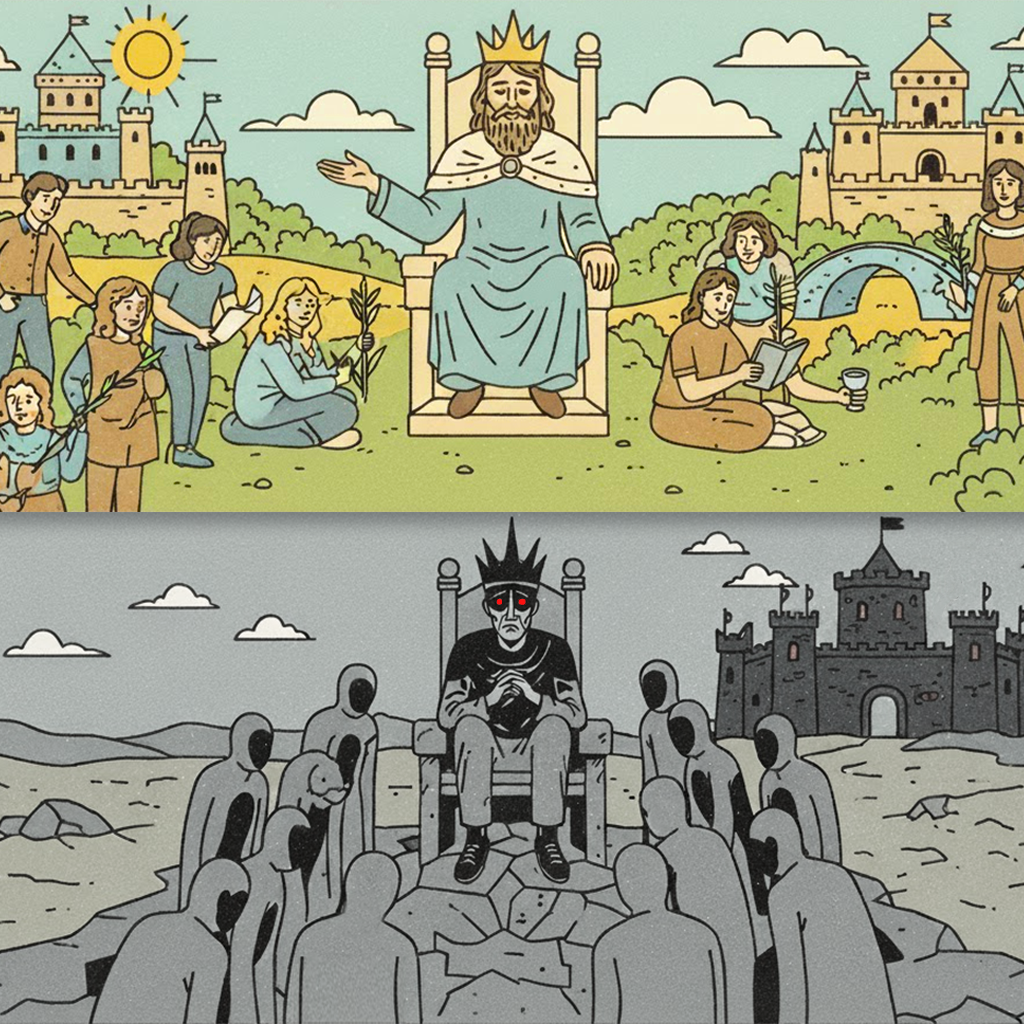
The study of leadership, stripped of its transient political context, reveals a fundamental division: the King Archetype and its shadow counterpart, the Shadow King or the Tyrant. The King represents the integrated, ordering principle of the collective Self—the leader whose virtue ensures the generativity, stability, and prosperity of the system he governs. The Shadow King, however, is not merely an ineffective leader, but a pathological archetype. His ascent provides the ‘supply’ side of the authoritarian dynamic (see the article America’s Father Complex for the ‘demand’ side of the equation), offering external order to a populace hungry for it, while being internally motivated by a deep-seated fear. His entire reign is a desperate, destructive effort to maintain a fragile illusion of power, necessitating the ruthless extraction of absolute loyalty and the elimination of all perceived opposition.
The Virtue of the Integrated King
In its integrated and healthy expression, the King Archetype is defined by benevolence, stability, and generosity. The true King serves as the calm, centered axis around which the community revolves. His function is to protect the boundaries, bless the land (or the system), and promote the wellbeing of his people. He is secure in his role, capable of wise delegation, and is open to receiving honest counsel because his authority flows from internal integrity, not external posturing. The integrated King creates a system built on trust and competence, providing the security that allows individuals to flourish independently.
The Descent into the Shadow King
The transition from King to Shadow King is not a shift in policy, but a fatal psychological collapse driven by a single, critical neurosis: a profound, unacknowledged fear of weakness. The Shadow King is not powerful; he is perpetually terrified of being exposed as inadequate, empty, or unnecessary. This internal deficit consumes the leader’s ego, replacing generativity with a narcissistic compulsion for validation. This fear manifests as debilitating paranoia, causing the Shadow King to distrust any independent competence or counsel. He increasingly isolates himself, surrounding himself only with figures who reflect his idealized image, turning the kingdom into a reflection of his own fragile, isolated psyche.
The Tyrant’s Compulsion to Extract Loyalty
For the Shadow King, power is not a responsibility to be exercised, but a resource to be consumed. Because his ego is fragile and dependent on external validation, he requires absolute, continuous adoration to prevent the anxiety of his internal void from overwhelming him. This need dictates the criteria for participation in his inner circle: loyalty replaces competence. Independent strength is now viewed as an existential threat. Competent individuals who operate outside of his personal magnetic field cannot be trusted, as their success proves the existence of value outside of his control. The Shadow King’s system thus becomes a mechanism for testing and extracting fealty, rewarding submissiveness while punishing autonomy.
The Necessity of Destruction and Dissent Elimination
The ultimate destructive act of the Shadow King is the attack on truth itself. Because his power is built on a lie—the illusion of his own unbreakable strength and wisdom—he cannot permit any external reality that contradicts his self-definition. Dissent is not viewed as a political challenge; it is seen as a psychological attack on his person. To manage his paranoia, the Shadow King constantly externalizes his own internal chaos, creating and emphasizing foreign or domestic “enemies” to unite his followers through shared fear. By relentlessly attacking and attempting to eradicate any alternative narrative, fact, or source of dissent, the Shadow King solidifies his control and momentarily relieves the anxiety of his own exposed vulnerability.
Conclusion
The Shadow King is the ultimate example of archetypal power gone awry. His reign, far from being a demonstration of strength, is the chronic expression of internal weakness and neurosis projected onto the collective stage. He is a self-cannibalizing force, offering the short-term illusion of certainty and protection in exchange for the long-term vitality, competence, and truth of the entire system. Understanding the Shadow King archetype is crucial: he is a necessary, albeit destructive, mirror reflecting the profound psychological pathology that can arise when a leader’s unintegrated personal fears are granted collective power.
This article is part of a three-part series, the other two articles:
The Economy of Authoritarianism: Supply-and-Demand Between King and Collective
and


