The rise of authoritarian structures isn’t just a political trend; if we look deeper we’ll see it’s a psychological bargain enacted on the grand stage of the Collective. To truly grasp the vulnerability of any complex society, we must look past transient events and personalities, and analyze the psychic ‘supply and demand’ transaction that creates and sustains these autocratic systems.
This series of articles dissects the authoritarian dynamic into its essential components, drawing heavily on Jungian psychology, particularly the interplay of foundational archetypes and the Shadow—both the Individual Shadow and the Collective Shadow.
Supply: The King, The Shadow King, and the Collective Need
The first half of the equation, explored in Rise of the Shadow King, is the ‘supply’. On a collective scale, the King Archetype represents the integrated, ordering principle—the leader whose integrity ensures the stability and prosperity of the system.
However, when this archetype collapses, it yields the Shadow King (or Tyrant King). This pathological leader is driven by a deep, unacknowledged fear of weakness and projects that neurosis onto the state or system. His entire reign becomes a desperate effort to maintain an illusion of power, necessitating the elimination of dissent and the demand for absolute loyalty. The Shadow King relies on the collective’s desire for an external Father figure to validate his internal emptiness.
Demand: The Unintegrated Father Complex
The second half of the equation, the ‘demand’, is addressed in America’s Father Complex.
The Father Archetype is the blueprint for structure, law, and internal authority. When this archetype is not successfully integrated within the individual psyche, it leaves a profound void: the Unintegrated Father Complex. This psychic deficit translates into pervasive anxiety, a fear of boundless freedom, and a desperate search to outsource internal order. The populace, hungry for certainty, idealizes any figure who projects hyper-masculine confidence and strength, inevitably mistaking authoritarian rigidity for genuine, integrated leadership.
The Mechanism: The Shadow Bargain
The critical link between the ‘supply’ (the Shadow expression of the King archetype) and the demand (the Father Complex) is the Shadow. The unconscious bargaining happens when the Individual Shadow’s unmet need for order aligns perfectly with the Collective Shadow’s pathology through an unconscious syntonic relationship.
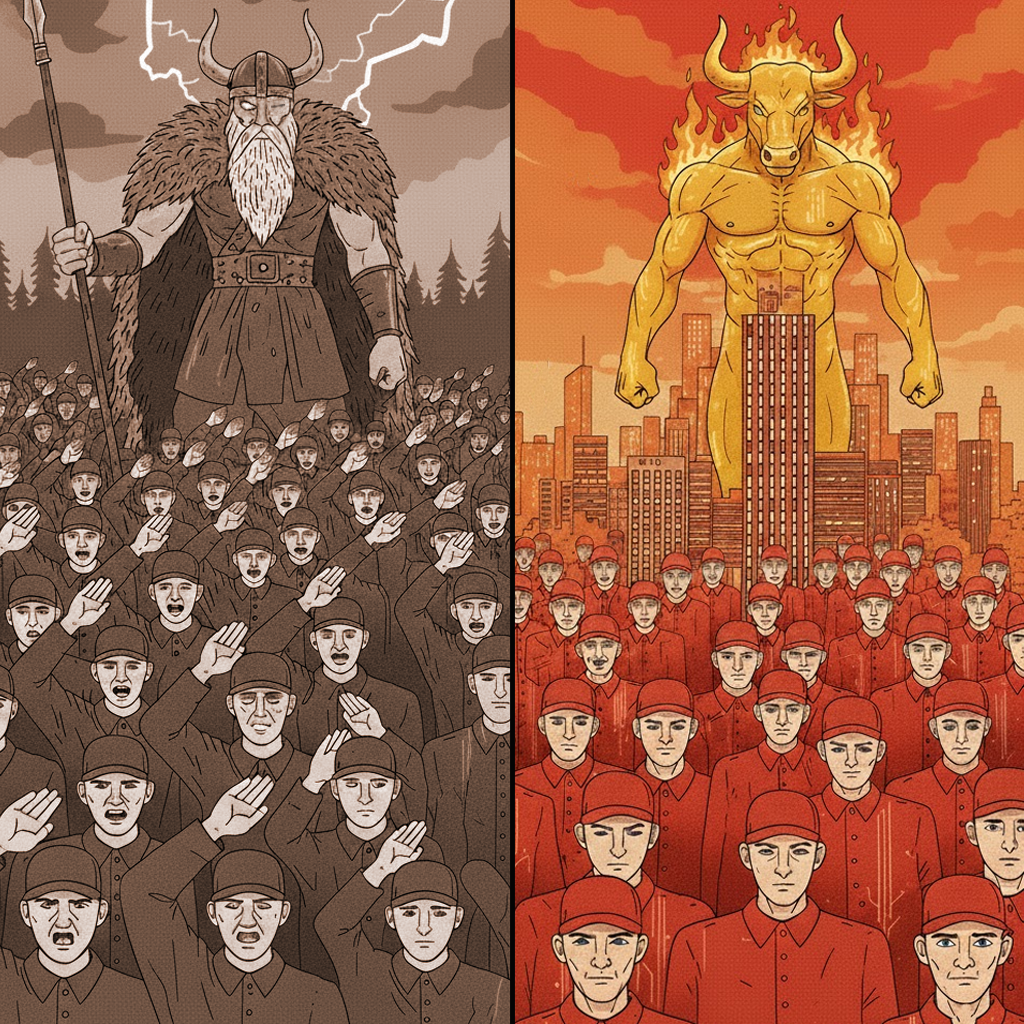
This dynamic is critically enabled by the psychological process of projection. Projection is the unconscious defense mechanism where undesirable thoughts, feelings, or qualities—often arising from the unintegrated Shadow—are disowned and perceived as belonging to another person or group. The Shadow King projects his internal fear of weakness and neurosis onto the state (e.g., seeing dissenters as existential enemies), while the populace projects its unmet need for order and internal authority onto the strong external figure.
The authoritarian leader (the Shadow King) steps into this collective void. His destructive impulses—his war on truth, his creation of external or internal ‘enemies’ or threats—align precisely with the psychological needs of his followers, who are desperate to externalize their internal chaos. By attacking what they perceive as disorder, the Shadow or Tyrant King validates the populace’s deepest fears, thus solidifying their devotion.
Ultimately, the authoritarian bargain is a dangerous exchange: the illusion of external certainty in return for the systemic suppression of competence, truth, and individual maturity. Understanding this psychological ‘supply and demand’ chain is the first step toward reclaiming psychological sovereignty.
This article is part of a three-part series, the other two articles:
and