The Resurrection of Sleeping Gods
In his 1936 essay ‘Wotan,’ C.G. Jung examined a fevered, divided Germany and saw something far deeper than a political platform. He saw the shadow side of Wotan—the ancient Germanic evolution of Odin, the god of storm, frenzy, and the wanderer who stirs strife—waking from a centuries-long slumber. Jung’s controversial essay posited that the German people were not merely supporters of a movement; they were seized by an autonomous psychic force that bypassed individual will and expressed the rage of a forgotten god.
That diagnosis was not without its critics: Jung was accused, with some justification, of aestheticizing the very possession he claimed to analyze—making something monstrous sound cosmically inevitable. We should hold that warning closely as we proceed.
The Brown Shirt was the outward apparel of this seizure. Wotan was the archetype of kinesis and tribalism: an intoxicating wind of destiny blowing through the collective psyche. But archetypes aren’t mortal; they’re not finite. They simply wait for a new set of circumstances to provide a new opportunity…or potentially, a cohort.
As we navigate this moment of the 21st century, the question is whether the nativist storm of Wotan has been replaced—or merely joined—by a different deity. The premise of this article isn’t that we’re merely seeing the emergence of Baal as a replacement for Wotan. I’d posit that we’re witnessing Baal arising alongside Wotan… but the old Storm God has not fully departed. It’s unclear whether this is an evolution or an uneasy partnership.
Wotan: Identity through Separation
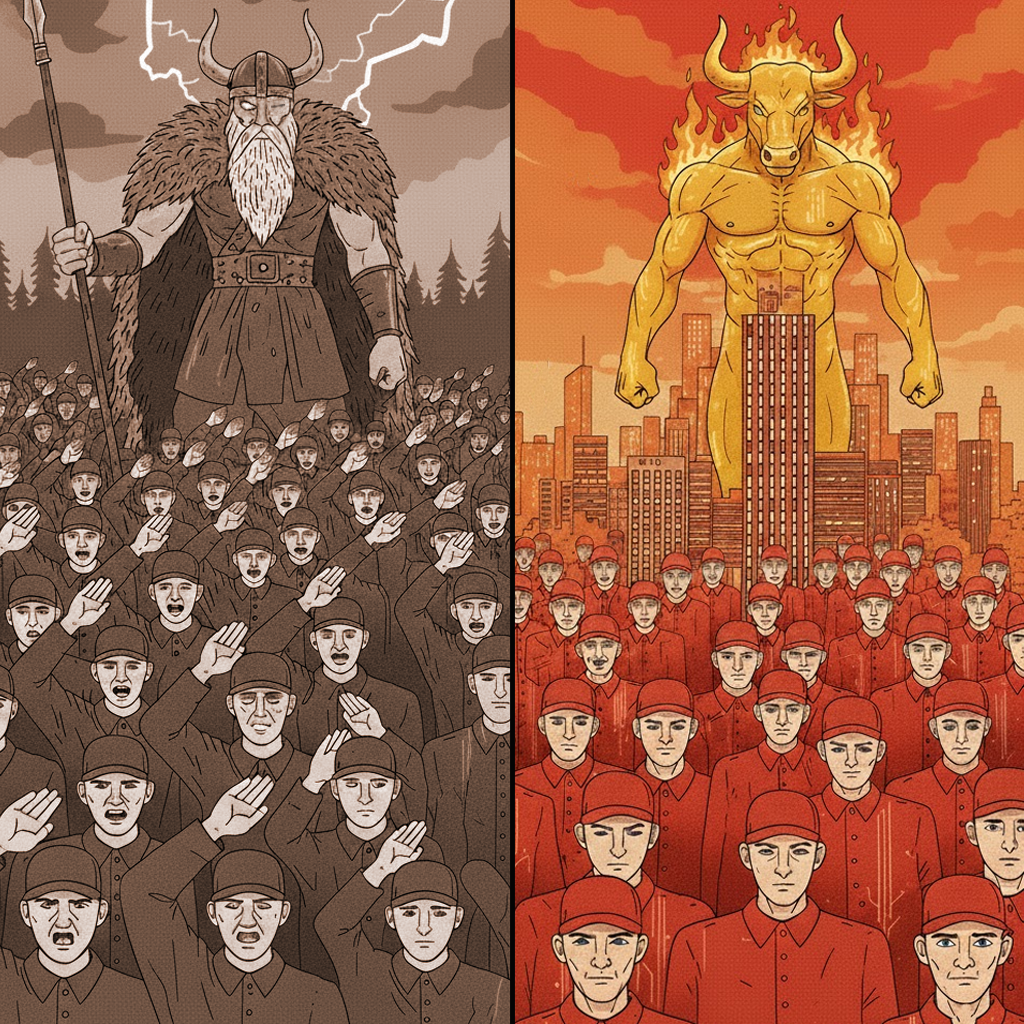
Wotan is the god of the berserker and the wanderer who stirs strife. His power is rooted in the tribal and the elemental. Psychically, he functions through separatism and war—carving the world into Blood and Soil, a Sacred Motherland, and a violent distinction between ‘us’ and ‘them.’ The Brown Shirt was the vestment of this violent boundary-making: a manic attempt to find identity by cutting everything else away, eventually culminating in the ultimate separation and annihilation.
Wotan is not absent from the contemporary moment. The nativist energies alive today—the border obsessions, the replacement anxieties, the ‘othering’ of immigrants, and blood-and-soil rhetoric—are recognizably his. Any honest account must hold this. The claim is not that Wotan has been replaced, but that a second sleeping god—Baal—has risen to join him, and the combination produces something distinct from either alone.
Baal: Identity through Transaction
The release of the files has pulled back a curtain that many would’ve preferred to keep drawn—behind it, the shadow of another god appears to be waking up. Baal is the god of fertility, hierarchy, and the high-stakes deal—the fiery deity of the casemate wall, the high-towered counting house, tophets filled with urns of the cremated remains of infants, and the bronze altar. Where Wotan’s identity is carved from blood and enemy, Baal’s shadow is born from the corrupted ledger and manipulative power structure. In the world of Baal—one is defined by what one owns, what one has traded away, and whom one has outmaneuvered. In Baal-consciousness everything has a price; material success is the only operative grace. Any means used to achieve influence, wealth, or power are sanctified by the profit margin and/or movement up the ladder. The highest bidder is the most hallowed hierophant.
The Red Hat is the headgear of the stakeholder; the eager ladder-climber. It signals an identity rooted in transactional wealth and protectionism—a belief that proximity to power and the perception of ‘winning’ constitutes sufficient moral justification for whatever must be surrendered to get there. It is a transaction-dressed-as-devotion laid on the altar—ethical integrity surrendered to ensure that the god of the deal will pay out in the future with power, influence, or money.
The Collective Possession
When Wotan dominates, the moral compass is replaced by a map of strict territories of ‘us’ versus ‘them’ enemies. When Baal dominates, it is replaced by a ledger and an agenda of quid pro quo. The particular danger of this current moment is that both are operating simultaneously: the Wotanic energies supply the tribal heat and the sense of existential threat, while the Baal-energies supply the transactional logic that converts that intent into cannibalistic policy and the redistribution of wealth upward.
Where Wotan demanded the sacrifice of ‘the Other’ to preserve the tribe, Baal demands the sacrifice of ‘the Future’ to preserve the wealth, influence, and power of ‘those above’ in the hierarchy. The Red Hat didn’t replace the Brown Shirt; it is not the death of one archetype and the birth of another—it is a uniform, in which the newer possession is the ‘hat’ of the corrupted logic while the older one, the ‘shirt,’ supplies the shadow emotional drive.
To wear the red hat is to participate in a compound transaction: individual ethics traded for perceived security, proximity to power, promise of influence, and the label of ‘winner.’ To wear the brown shirt is to invest in the dark impulses of tribalism. The uniform of the supplicant, making offerings on an altar that serves both the Golden Calf and the Storm God.
A Note on the Limits of the Framework
Jung’s archetypal method is illuminating precisely because it operates at the level of collective psychic pattern. But it carries a real risk: it can make archetypal possession sound sublime and inevitable, and therefore beyond moral accountability. This should not be interpreted as mystifying political agency until it becomes unrecognizable as human choice. The people inside these movements are not simply vessels of gods. They are moral agents making choices. The archetypal framework helps explain the shape of the possession; it neither excuses it nor relieves us of the responsibility to name it plainly.