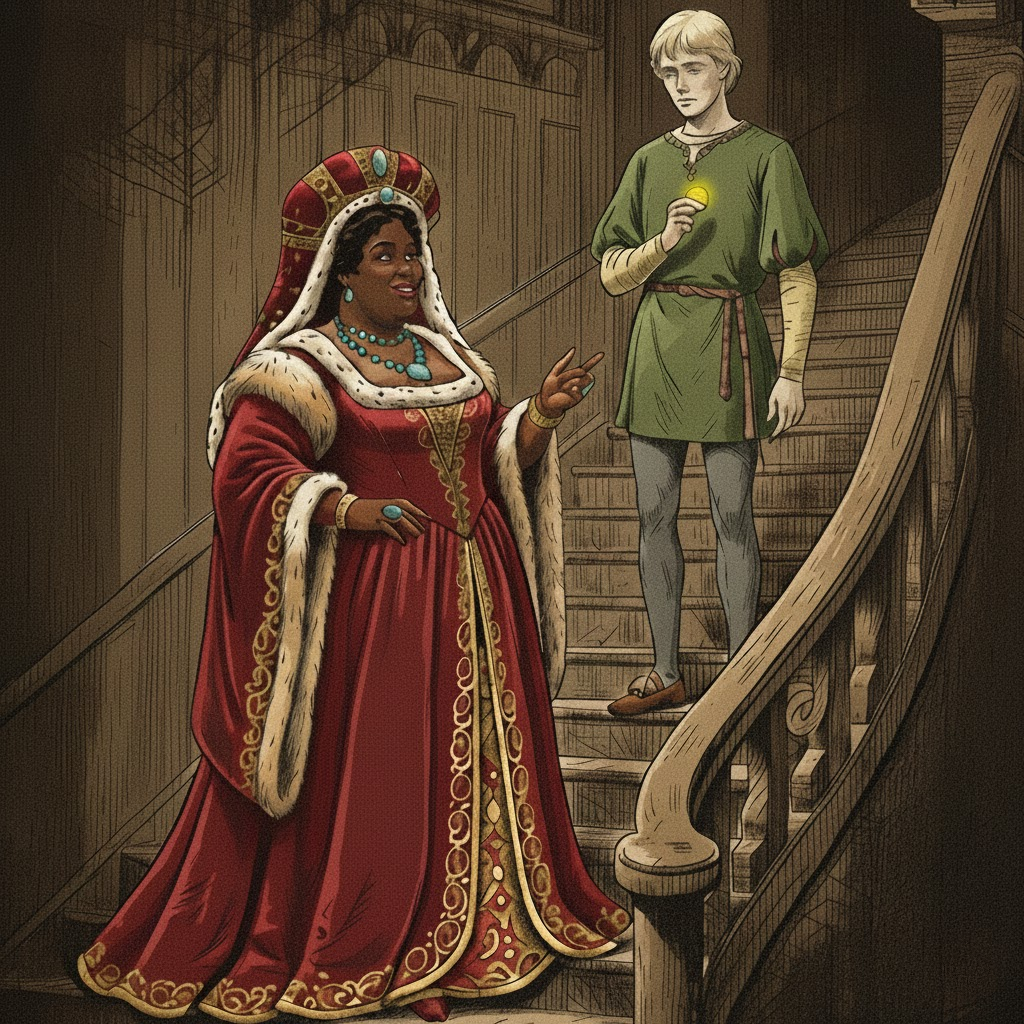
Once upon a time, in a kingdom not so very different from our own, there lived a young man, impervious as an uncracked egg, who possessed but a single gold coin to his name. Yet what he lacked in wealth, he made up for in singular determination — for he had been overtaken, as young men are, by a certain clumsy urge — the wish to shed the burden of unmet intimacies.
And so, as young men do when desire outpaces wisdom, he made his way to that particular establishment in town; that place of a certain reputation — the place accustomed to certain young men overtaken by certain clumsy, basal urges. Urges more stem than rose. A tall, candlelit, lust-spent house at the end of a cobblestone lane, where red silk hung in the windows and music stole out into the evening air. A place sought not by reason, but by bone; descried only when the night was ripe.
He rapped upon the august, venerable door — a door more beseeming of a sanctum.
Rap… Rap… Rap…
A too-long-tarry. Then, finally. The way parted with solemn gravitas.
With misdoubt he asked for the Madam of the manse.
“I am she,” a deep, lyrical edict; sung not said; voice, color of molasses.
The Madam was a regal woman of certain experience and considerable girth, dressed in velvet the color of deep scarlet—ever-bloomed of sorts; eternal; long past first-scent. She listened to the young man’s plea with a patient ear, then cast a long and knowing eye upon his solitary coin. With scant nod and fleet ken, she gestured; he ensued.
She led him through luxuries of dimly-lit, well-appointed parlors, to the stairs. As they walked abreast, the young man gazed thoughtfully at the Madam — at the deep scarlet of her. Head-cock; chin-tilt; side-glance and faint shade of smile. The warmth and the wit and the terrible knowing in her eyes. Looking not quite exactly at him, but into him; even past him; through him.
Something in him stirred that was older and deeper than what brought him here.
“What about you?” he asked, timidly, with hesitation, perhaps a slip.
The Madam looked at him the way one looks at a child who has just asked something both sweet and hopeless. Then she smiled — not the smile she wore for business, but something quieter and more final — and patted his cheek once, with a single ringed hand.
“I would cost you all that you have,” she said. “No, not a single golden coin. No. Everything.”
She let that sit between them for a breath.
“And you, my dear, are not ready for that yet.”
Then she turned, with a sweep of her scarlet skirts said, “But I can help you. For one coin, we must descend to the basement — for that is where the rarest of my brood do bask. Treasures, each one, in their own singular fashion. Each one a jewel. Not prisoners; not tenants; kith and kin, each; all sovereignties of their own domain. Priceless, yet… rarely claimed.”
He agreed, and down the ancient, well-worn stairs they went. There, below, a long, dim, dark-paneled hallway waited ornately. Curiously, eerily, not uncomfortable nor uninviting.
The first door the Madam opened revealed a trull of most wretched condition — incontinent and unashamed, bothered not; lying amidst piles and puddles, evidence of her glories and contritions. The stench rose up like a curse.
“This room holds one whose indignities are many and whose dignities are few; yet, unsullied, she abideth still,” said the Madam, with a sweep of her arm.
“Egad! No!” cried the young man. “This is not the garden in which I wish to plant my first flower!” And the door was shut.
The second door opened upon a harlot of abundant warmth — soft and full, her arms open. Something stirred in the young man that had no name and no language; older than words. An infant’s memory, not of mind but of body. Warmth. Safety. Swaddling. First sweet taste of life. The feeling so tender, yet strange; desire curdled to confusion in a trice.
“This room holds one whose love asks nothing and refuses nothing,” said the Madam.
“No,” said the young man, quietly, almost sadly. “This is not the love I came here for.” And the door was shut.
The third door opened upon a strumpet most peculiar in her construction — arms where legs ought be, legs where arms do grow. A lass refigured by arcane enchantment.
“This room holds one whose form may not be usual,” said the Madam.
“No! This is not the shape of my desire!” he winced. And the door was shut.
Beyond the fourth door stood not a maiden but a young man — a catamite. Handsome enough in his way, he smiled with pale, merely-dutiful enthusiasm, though, behind, an ever-slight ember glint.
“In this room ye may be yielding ewe or rutting ram; control surrendered or seized; either, both; the choice entirely yours,” said the Madam.
“No! It isn’t good and proper for my first time!” said the virgin, dismayed. And the door was shut.
The fifth door opened upon a young minx who looked up from her book with bright, calm eyes. Eyes that caught his own reflection in them, vaguely, almost imperceptibly, like his own face seen in shimmering water. She did not proposition him. In her he felt himself suddenly.
“This room holds one who would meet you equal in all things,” said the Madam.
“No,” said the young man, unsettled in a way he could not name. “She is too much like me.” And the door was shut.
The sixth door revealed a crone of extraordinary age. Ancient and weathered as a battlement, yet willing still, her eyes fire-flicker-gleaming like those of an owl in the dark.
“This room holds one whose wisdom is matched only by her years; torch in place of spark,” said the Madam, with a dignified nod.
“No! I would not have winter be my first season!” said the young man, face fret. And the door was shut.
Behind the seventh door, a jungle, not room, crouched something wild and feral — wanton, untamed by civilization, who hissed and scratched at the air between them. Lilithine and lithe. The young man stumbled backward in fright.
“This room holds one who has never been broken to bridle nor saddle; not civilized nor civil,” said the Madam, stepping neatly aside.
“No! I wish to be the wild one, not the tamed!” cried the young man. And the door was shut.
The eighth door opened upon a courtesan of indeterminate age — neither young nor old, neither plain nor beautiful. Eyes so still and so penetrating. The young man felt them move across him like a lantern held in a dark room. She saw not just the contours of his desire but the anatomy of everything beneath it — his shame, his guilt, the small frightened center of his wanting.
“This room holds one who sees all that you are,” said the Madam, almost gently.
“No,” said the young man, stepping back, his voice tight. “She is dangerous. She sees me now naked.” And the door was shut.
The ninth and final door opened upon a sight most grim — a whore departed from this mortal world, yet still warm, still pliable, as though death had only just that moment called.
“This room holds one who is beyond all complaint and all refusal,” said the Madam, reverently, with scant obeisance. She intoned, bow-headed, near silent, submisse, “In nomine Matris, et Filii, et Spiritus Sancti.”
“No!” said the young man, his voice barely a whisper. “I would have my first memory be of life, not of its absence.” And the door was shut.
The Madam planted her feet and set ringed fists squarely against her hips.
“Those,” she announced, with an air of conclusion, “are your choices.”
The young man fell to his knees. He begged. He pleaded. He invoked every star in the sky and every saint he could remember. “Please,” he implored, “I have but one coin and one wish and I cannot go home as I arrived!”
The Madam regarded him for a long moment, tapping one ringed finger against her chin. Then, as if revisiting a thought… a memory… or a secret she had been holding in reserve, she said,
“There is… I suppose… one other door.”
She led him to the very end of the hall in whist, to a shadowed door, afore unseen.
She opened it, nay a word.
The room within was alabaster white, floor to ceiling. As pure and as empty as a chapel. Candles burned at the four corners. There, upon a fane of smoothest, whitest stone, lay a res. A figure of the most exquisite porcelain — white as moonlight, still as a winter pond — cold and stiff. Fragile as a dream. Not-quite-legs splayed just so, displaying, in precisely the right place, precisely the right niche.
In quietude, a single, nearly-unheard breath; a hollow sound betwixt sigh and pant, his “Yes…”
The young man’s face broke into a slow and wondrous smile — heat rising; enflamed; stiffened. He placed his single gold coin in the Madam’s waiting palm. She stepped out of the room, closing the door behind her.
After a time, the door opened. He retraced the hall to ascend the stairs with the stride of a man transformed; beaming, breathless, unburdened; nearly ebullient.
He bowed low, graciously even, to the Madam and thanked her effusively, as one reborn through deepest coupling, for the pluck of his firstfruit.
The Madam smoothed her velvet skirts and looked upon him with the patient sorrow of someone who has explained difficult things to young men many, many times before.
“You are welcome,” said she, voice dry as parchment; final as the writ word, “but, sorrows, lad… ye remain untouched… virgin still.”
He argued. He objected. He appealed to the rule and record of his own pilgrimage. To reason. To satietas. He petitioned angels and devils; invoked gods both pagan and hallowed.
With nary heed, she pointed him out; cast back into the night.
The young man skulked away; a gold coin poorer. No wiser than when he had entered; every bit as inexperienced as the moment he first arrived.
And he has yet to figure out why; mayhaps, soonly, the rose.