After watching the internet explode with wild speculation about a missing/invisible leader over the past few days, I had to ask myself, what will be next? When ‘it’ happens, and he’s no longer here… what will we do as a nation? How will we reckon with our collective shadow? How will we reunify… or will we?
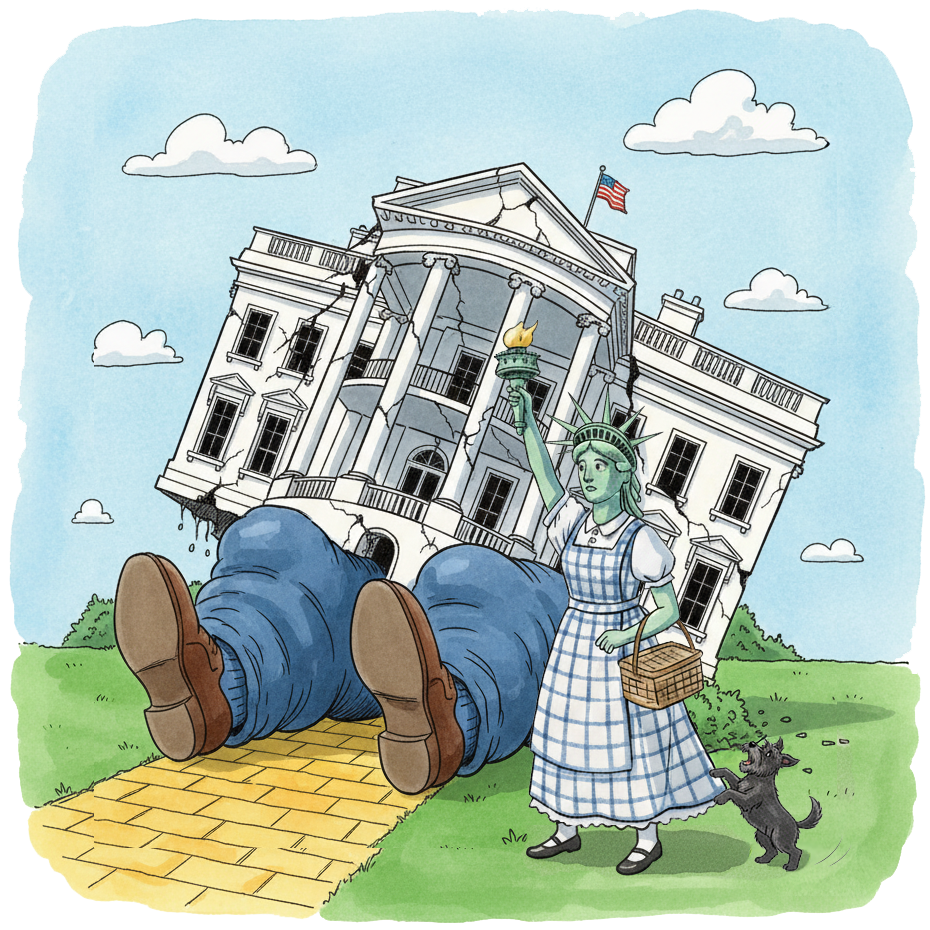
In The Wizard of Oz, Dorothy’s house doesn’t just land in Oz; it crushes the Wicked Witch of the East, instantly making our Kansas farm girl a hero. But what if the witch’s death represents something far more unsettling than liberation? At least half the Munchkins will be celebrating—the other half will be mourning. But what comes next for the collective?
The Comfort of Our Internal Enemy
The Wicked Witch serves as Oz’s internal shadow, not a foreign invader but a domestic threat, someone who was once part of the community before becoming its defining villain. This makes her both more intimate and more psychologically necessary than any external foe.
We’ve created our own version of this dynamic. Our current internal enemy serves as a convenient repository for everything we cannot bear to acknowledge about ourselves as a nation. As long as this figure exists, we can point inward and declare, “There is the source of our decay. There is what we must purge to be pure again.” Half the country sees salvation in his presence, the other half sees corruption—but both sides have organized their entire political identity around his existence.
But what happens when our collective shadow witch finally falls?
The Terrible Inheritance
When Dorothy inherits the ruby slippers, she doesn’t just gain power; she inherits the dead witch’s role. The line between corruption and purity, so clearly drawn moments before, dissolves completely.
This is the moment we’re approaching. When our defining internal enemy disappears, the shadow doesn’t vanish; it returns to all of us. The qualities we’ve projected onto this one figure must suddenly be acknowledged as possibilities within our entire political system. The uncomfortable truth will emerge: what if the capacity for authoritarian impulses, moral corruption, and democratic backsliding wasn’t an aberration but something endemic to our moment?
Those ruby slippers, the power that once belonged to the villain, don’t disappear. They get passed on. To whom? And what will they do with that inherited power?
A Nation Without Its Central Villain
When we lose our defining internal enemy, I’d expect we’ll face what might be called a ‘post-villain crisis.’ All that collective energy, all that organized opposition and support, will need somewhere to go.
Some will rise to this challenge, using the moment for genuine institutional reform and honest self-examination. They’ll ask: What did we avoid confronting about ourselves while we were focused entirely on him? What foundational problems require attention once the distraction ends?
Others will immediately begin hunting for new internal enemies, unable to function without someone to define themselves against. The most dangerous possibility is that we fracture completely, each faction casting the other as the new internal villain, trapped in an endless cycle of mutual demonization.
There’s No Place Like Home
Dorothy’s ruby slippers always had the power to take her home; she simply had to learn to see home clearly, shadows and all. Her journey wasn’t about defeating evil but about integrating the knowledge that good and evil exist within the same community, the same system, and the same heart.
For us, the end of the villain era won’t be victory; it will be the moment when the real work begins. Not the familiar work of resistance or support, but the much harder work of rebuilding a democracy that can function without a central figure to organize around, either for or against.
The yellow brick road, it turns out, was always a circle. The question is whether we’ll walk it with the wisdom to see ourselves and our institutions clearly, or whether we’ll spend our post-villain years desperately searching for the next witch.
When ‘it’ happens, we’ll discover what we’re really made of. Are we Dorothy, ready to click our heels and do the hard work of getting home? Or are we just another group of Munchkins, celebrating the witch’s death while remaining naive and helpless until the next crisis arrives?