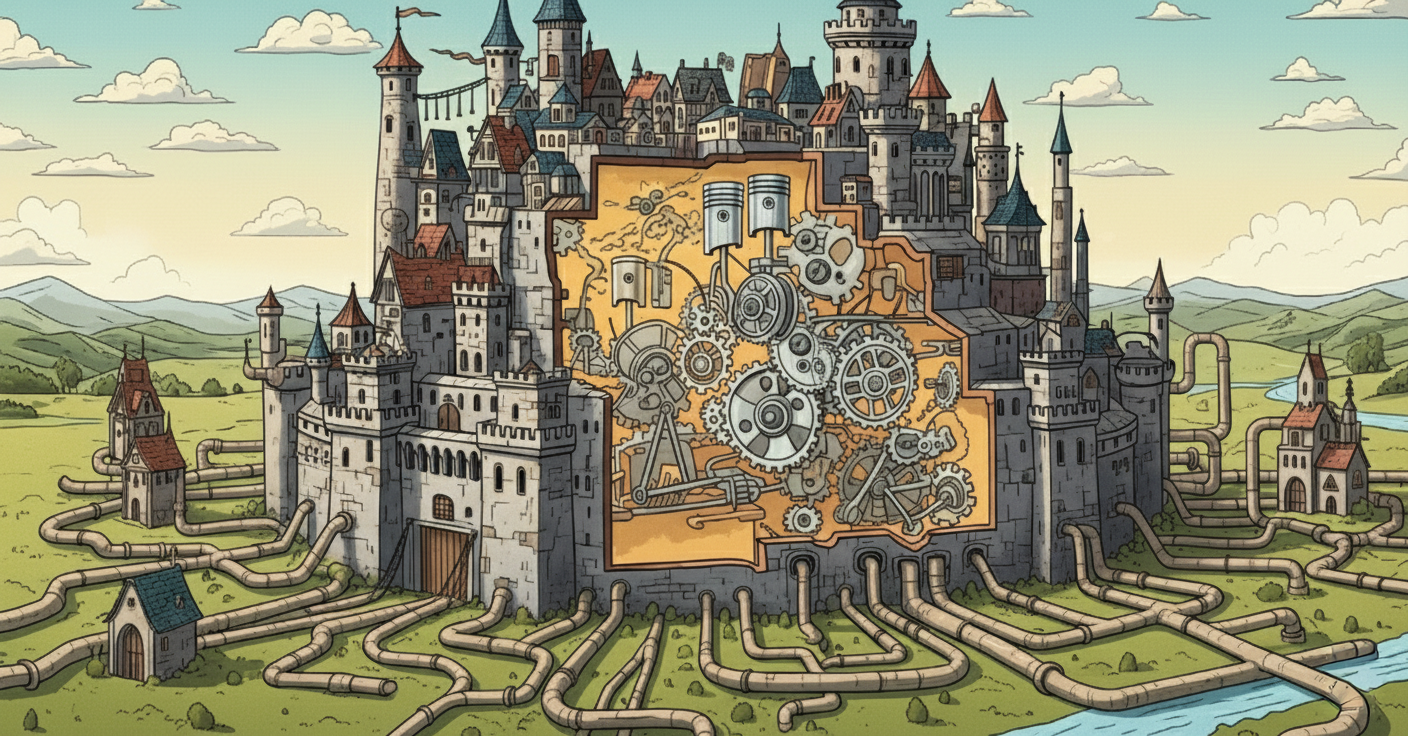
Now that we’ve explored what extractive systems are and how they make us feel so drained, let’s pull back the curtain and examine how they’re actually structured. Because here’s the thing: extraction doesn’t just happen randomly. It’s built on a predictable blueprint that has existed for centuries, from ancient feudal systems to modern digital platforms.
Understanding the structure isn’t just academic—it’s practical. When you can see the blueprint, you can better identify where you fit within these systems, better assess their impact on you, and make more informed choices about your participation.
Three Levels of Extraction
Extractive systems operate on three distinct levels through the Architecture, each with its own role and relationship to the others. Think of them as layers in a hierarchy, each extracting value in its own way.
Level 1, The Macro/Host System – The Top: Here we have the big players—the macro or host systems that set the rules and extract the most value. They consume more from the collective than they supply back, concentrating benefits toward the top.
- Modern Example: A social media platform that harvests your attention, personal data, and behavioral patterns in exchange for ‘free’ social connection—though we’re learning that connection isn’t really free at all.
- Historical Example: Feudalism, where lords extracted labor, crops, and military service from serfs in exchange for protection and access to land that the lords ultimately owned.
Level 2, The Paraextractive System – The Middle: This is where things get interesting. Paraextractive systems operate within or alongside the host systems, but they run their own extraction game. They’re semi-autonomous, often invisible, and they add their own layer of value extraction beyond what the host system already takes.
- Modern Example: The third-party advertising tools or logistics companies that operate within a major e-commerce platform, extracting additional fees from sellers while being dependent on the platform’s infrastructure.
- Historical Example: Company stores in early industrial operations. They operated within the factory system but extracted additional value from workers’ already suppressed wages through inflated prices for essential goods, creating debt bondage.
Level 3, The Subextractive System – The Bottom: At the ground level, subextractive systems do the direct enforcement work. They’re completely dependent on the higher-level systems and typically have direct contact with the people being extracted from.
- Modern Example: Credit reporting agencies that serve financial institutions, extracting your personal financial data to help lenders make more precise extraction decisions through risk pricing.
- Historical Example: Roman tax collectors operating within the Roman Empire’s vast system of conquest and tribute, these individuals were hired to collect taxes from the population on behalf of the state, often extracting additional wealth for themselves in the process. They were the direct, on-the-ground interface between the ruling system and the people.
The Extraction Model: How It All Happens
Within this three-level Architecture, extraction operates on the members of the system through the Model. Understanding this pattern helps you recognize extraction as it’s happening and identify where you have the most leverage to respond.
It starts with a Hierarchy—asymmetrical levels of power that create the conditions for extraction. This creates a Subject (the one who benefits—the platform, the boss, the extractor) and an Object (the one who gets extracted from—the users, the employees, the extractee).
Next, a Resource is identified—the thing of value that’s actually being extracted. This could be money, attention, data, time, credibility, or even something as intangible as peace of mind. The Method is how it happens—the processes, technologies, belief systems, or practices used.
The Reasons are the justifications given for the extraction—expansion, ‘disruption,’ or simply ‘that’s how it’s always been done.’ The Impacts are the effects on those being extracted from—burnout, financial stress, or that drained feeling we started with. Finally, there’s always the possibility of Resistance, from setting personal boundaries to abandoning a platform altogether.
The Consistent Blueprint
What’s remarkable is how consistent these patterns are across different eras and technologies. The feudal lord extracting agricultural surplus from peasants follows the same basic architecture as a social media platform extracting attention and data from users. The methods and resources change, but the fundamental structure remains the same. The company store trapping workers in debt has direct parallels to subscription services that make cancellation nearly impossible.
This is why extractive systems are so resilient. Their three-level structure distributes the extraction work while obscuring responsibility. When you’re frustrated with a subextractive system, like a difficult customer service experience, it’s easy to blame the front-line worker rather than recognize they’re operating within constraints set by higher levels of the system.
Seeing the Blueprint in Your Life
Now that you can see this blueprint, you can start to read the systems around you more clearly. When something feels draining, ask yourself:
- What level am I dealing with? Am I interacting with the main system, a dependent service, or a front-line enforcer?
- What is actually being taken from me? Is it time, attention, data, or something else?
- Who ultimately benefits from this extraction?
This isn’t about becoming paranoid or cynical. It’s about developing the literacy to understand the systems that shape our daily lives. When you can see the architecture, you can make more informed decisions about where to invest your energy and how to protect what matters most to you.
This is the second part of a 3-part series. In our final post we’ll dive into nine key areas where extraction manifests in daily life, giving you practical tools to apply this framework and reclaim your well-being. If this resonates with you, my book, ‘Asleep at the Will: The Dormant Soul Complex,’ provides an in-depth analysis with case studies that apply this framework to real-world examples. Its forthcoming companion workbook, ‘Awake at the Will: Waking up to a Conscious Life,’ offers a clear path forward.