In our journey through this series, we’ve explored how individuals can reclaim their authentic power through Eudaimonic Sovereignty, and how sovereign individuals can create resonant communities through Koinonic Syntonomy. We’ve seen examples of conscious collaboration that amplifies rather than diminishes individual authenticity.
But what happens next? What occurs when these small generative/regenerative communities begin connecting with each other? When networks of conscious groups start coordinating their efforts toward something far greater than any one of them could achieve alone?
This is where we encounter the most ambitious vision in this conceptual framework: Autonomic Synergeia—the proposed dynamic coordination of sovereign communities working together to build truly generative/regenerative infrastructure at the societal level.
The Greatest Work of Our Time
We stand at a threshold. Around us, we see systems failing—economically, ecologically, socially. Meanwhile, small pockets of generative/regenerative alternatives are beginning to emerge: intentional communities, cooperative businesses, mutual aid networks, local currencies, ecological restoration projects.
But these remain largely isolated experiments. What if they could connect? What if the learning community in one neighborhood could share resources with the maker spaces in another? What if the regenerative farm collective could coordinate with urban community gardens to create a bioregional food system? What if the healing arts circle could network with other wellness practitioners to create alternatives to the extractive healthcare system?
This is the vision of Autonomic Synergeia: not just isolated pockets of conscious community, but interconnected networks of regenerative infrastructure that could fundamentally transform how human society operates.
Understanding Autonomic Synergeia
This concept weaves together two essential principles:
Autonomic (αὐτόνομος) means self-governing—living under your own laws rather than imposed control. We’ve seen this principle at the individual level (Eudaimonic Sovereignty) and the community level (Koinonic Syntonomy). Now it extends to the network level: interconnected communities that maintain their unique identity and autonomy while participating in larger coordination.
Synergeia (συνεργία) describes the collaborative working together of separate elements to produce something greater than the sum of their individual parts. In ancient Greek thought, synergeia wasn’t just addition—it was qualitative transformation through unified action.
Together, these create something unprecedented: large-scale social coordination that enhances rather than diminishes individual and community sovereignty. Instead of the traditional choice between chaos or control, we get emergent order—systems that self-regulate through conscious collaboration rather than imposed hierarchy.
What This Looks Like in Practice
Let me share three scenarios that illustrate how Autonomic Synergeia might manifest:
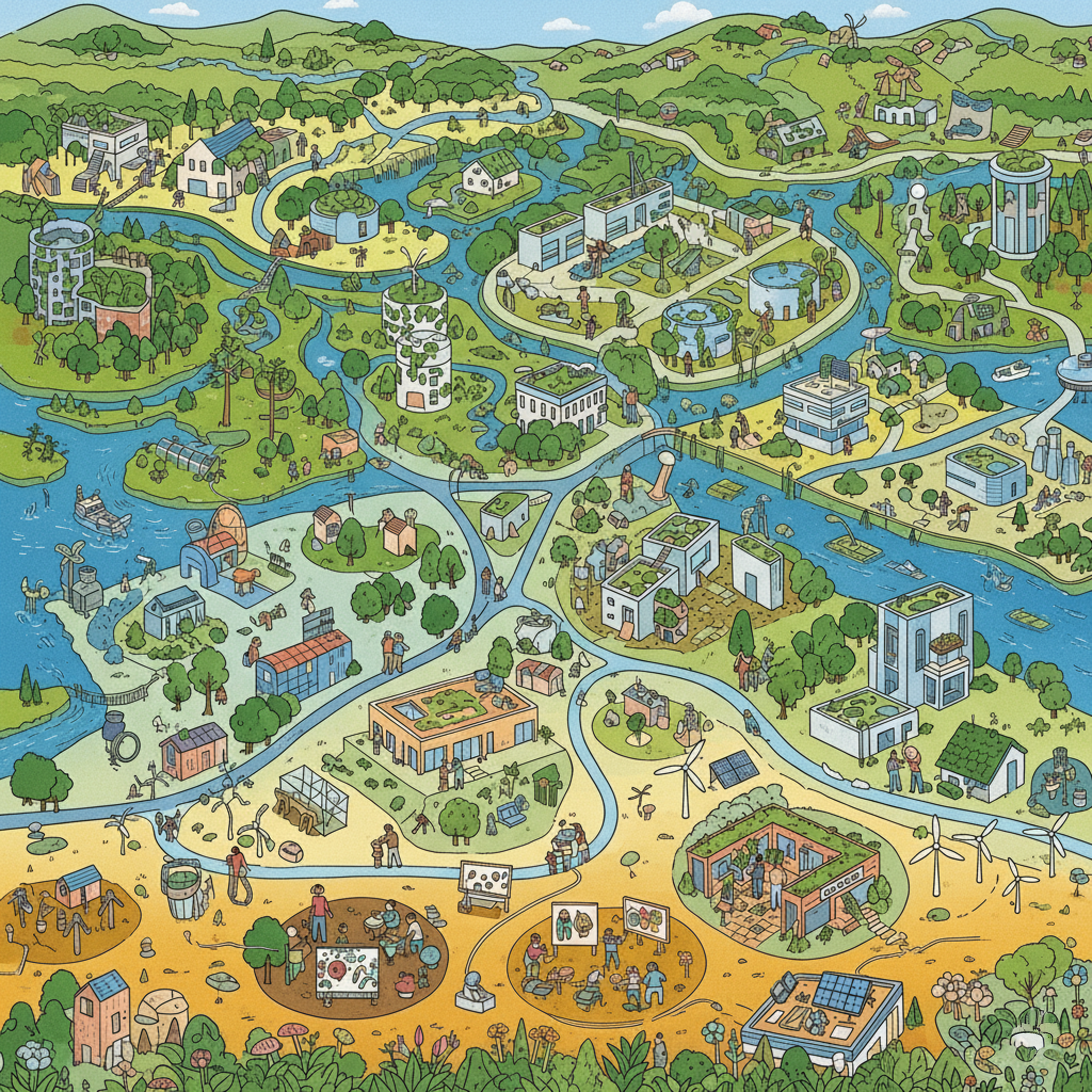
The Bioregional Network: Multiple communities across a watershed have developed interconnected systems. The farm collective coordinates with urban gardens to create regional food security. Learning communities share educational resources and expertise. Maker spaces collaborate on infrastructure projects. Healing arts practitioners create comprehensive wellness networks. Local currencies and gift economies keep wealth circulating locally. Regional decisions emerge through networked councils where each group maintains autonomy while contributing to bioregional wellbeing. The result: shared abundance through coordinated sovereignty.
The Urban Regeneration Movement: Neighborhoods maintain their unique character while participating in city-wide coordination. Tool libraries, community gardens, and care networks operate across boundaries. Community-owned businesses and cooperative housing reduce extraction. Renewable energy microgrids and composting systems are collaboratively managed. City-wide decisions emerge from neighborhood councils working dynamically with municipal government. Individual residents maintain sovereignty, neighborhoods preserve identity, and the city becomes a model of regenerative living.
The Professional Network Ecosystem: Partnerships across industries—design, technology, trades, wellness, education—form an interconnected ecosystem. They share expertise for complex projects, operate on regenerative business principles, and circulate resources based on capacity and need. Shared learning infrastructure benefits all members. Network-wide decisions emerge through representative councils while preserving each partnership’s autonomy. Their unified influence creates positive changes in industry standards and practices.
The Infrastructure Revolution
What makes Autonomic Synergeia revolutionary is that it addresses infrastructure—the underlying systems that shape how everything else functions. Instead of trying to reform extractive institutions from within, it builds parallel regenerative infrastructure that eventually makes the old systems obsolete.
This infrastructure operates through several key principles:
Distributed power that regenerates rather than extracts: Instead of power concentrating upward, it circulates throughout the network, strengthening each node while enhancing collective capacity.
Coordination that enhances individual agency: Rather than sacrificing autonomy for collective action, the network amplifies what each person and community can accomplish.
Self-regulating abundance: Instead of artificial scarcity created by hoarding and competition, collaborative systems create genuine abundance through circulation and sharing.
Emergent governance: Rather than imposed rules, agreements and decisions emerge through conscious coordination, constantly evolving to serve everyone’s flourishing.
Why This Matters Now
We’re living through the collapse of extractive systems and the simultaneous emergence of regenerative alternatives. Climate change, economic inequality, social fragmentation, mental health crises—these aren’t separate problems requiring separate solutions. They’re symptoms of extractive infrastructure that treats people and planet as resources to be consumed.
Autonomic Synergeia offers a different possibility: infrastructure designed for regeneration rather than extraction, coordination rather than domination, abundance rather than scarcity. It’s not utopian fantasy—it’s practical systems design based on principles we already see working in small-scale applications.
The Antifragile Society
Perhaps most importantly, this infrastructure is designed to be antifragile—becoming stronger through change rather than breaking under pressure. Unlike our current brittle systems that require constant maintenance and control, generative/regenerative networks become more intelligent, more capable, and more resilient as they evolve.
When one node faces challenges, the network provides support. When new opportunities arise, the whole system adapts. When crises emerge, distributed intelligence responds more effectively than any centralized authority could.
Your Role in this Work
This might seem impossibly large-scale, but it begins exactly where you are. If you’ve been developing Eudaimonic Sovereignty in your own life, you’re already contributing. If you’re part of or building conscious community through Koinonic Syntonomy, you’re creating the nodes that these networks could connect.
The question isn’t whether you’re qualified to participate in building generative/regenerative infrastructure. The question is: What unique gifts could you bring to the effort? What communities are you part of? What connections could you help foster?
Every sovereign individual, every co-creative community, and every connection between generative/regenerative groups—these are the building blocks of Autonomic Synergeia.
The Time is Now
We have the technology, the knowledge, and increasingly, the communities needed to build generative/regenerative infrastructure. I am convinced that the tools for transformation already exist—they simply need to be woven together differently. The insights of complexity science, the practices of restorative justice, the wisdom of indigenous governance models, the innovations in cooperative economics—these pieces exist in isolation right now. What we need is the vision to connect these scattered innovations into something greater than the sum of their parts.
The future isn’t something that happens to us—it’s something we build together. And the building has already begun.
This is the fourth and final post of a four-part series exploring the journey from individual sovereignty to collective flourishing. For the foundational concepts, check out the book ‘Asleep at the Will: The Dormant Soul Complex‘ and look out for the forthcoming workbook ‘Awake at the Will: Waking up to a Conscious Life.’