The Synchronicity of Shadow Manifestation
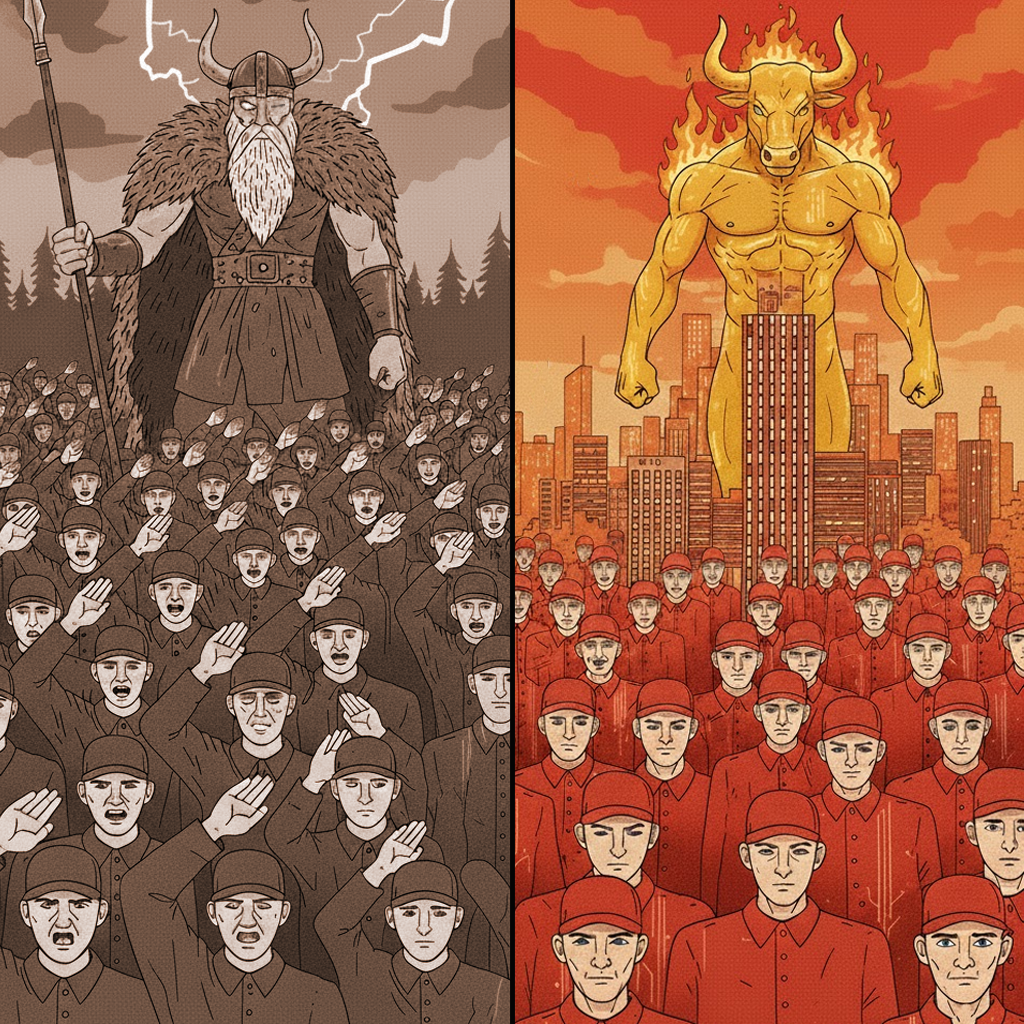
The clustering of these tragedies reveals the collective shadow’s modus operandi — not through linear causation but through synchronicity. Charlie Kirk’s assassination, the Mississippi hangings, another all-too-often school shooting: I’d posit that these aren’t discrete events but facets of a single phenomenon. Jung observed that when unconscious content reaches critical mass, it erupts simultaneously across multiple points in the collective psyche.
Consider the temporal pattern: these events emerge as America approaches what feels like a psychological breaking point, clustering around the anniversary of a significant national trauma, in this case 9/11. The collective unconscious doesn’t follow news cycles or political calendars, it operates on deeper rhythms. When a society’s contradictions become unbearable, the shadow finds expression through its most vulnerable members.
The immediate response to Kirk’s tragic murder proves the point. Within hours, both political camps were frantically researching the shooter’s background, desperate to confirm he belonged to ‘the other side.’ This isn’t political strategy; it’s psychological defense. The collective shadow uses such moments to force us to confront what we’ve disowned, and our reflexive response is to project it outward, anywhere but onto ourselves.
The Mississippi Archetypal Theater
Mississippi functions as America’s unconscious made manifest, the geographical repository of everything the nation cannot consciously acknowledge about itself. The state consistently ranks last in metrics that matter: education, healthcare, economic mobility, life expectancy. It’s as if the collective psyche has designated Mississippi to carry its shadow, allowing the rest of the country to maintain its idealistic self-image.
The hanging deaths there operate on multiple symbolic registers simultaneously. A Black man and a white man, both found hanging from trees, the shadow doesn’t discriminate by race but by society’s fundamental abandonment of its people. The tree itself carries archetypal weight: the axis mundi where heaven and earth meet, the place of sacrifice and transformation.
Authorities, thus far claim to have found ‘no foul play,’ but this misses the deeper truth entirely. The collective shadow creates conditions where such deaths become inevitable expressions of societal failure. We’ve constructed a society that systematically abandons certain populations — the mentally ill, the homeless, the economically displaced — then express surprise when they become casualties.
The geographical specificity matters too. These weren’t deaths in anonymous urban settings but in the heart of America’s racial trauma theater. The collective unconscious has a sense of dramatic irony-it stages its revelations where they carry maximum symbolic weight.
The School as Sacred Target
Our far-too-frequent school shootings represent the collective shadow’s most perverse expression: society’s attack on its own future. These institutions embody our highest conscious ideals: education, growth, innocence, possibility. When the shadow targets schools, it’s attacking the very notion that we can transcend our current condition.
The repetitive nature of these events suggests ritual rather than pathology. The same script plays out repeatedly: alienated young person, access to weapons, targeting of innocents, media saturation, collective hand-wringing, then forgetting until the next iteration. This cyclical pattern indicates we’re dealing with something far deeper than individual mental health crises or policy failures.
The shooters themselves become unwitting agents of collective shadow expression. They carry the rage, despair, and nihilism that the broader society generates but refuses to acknowledge. Their individual pathology becomes the vehicle for collective pathology to express itself.
The Mental Health Smokescreen
The reflexive turn to ‘mental health’ explanations serves the shadow’s purposes perfectly — it localizes collective problems within individual psyches. This isn’t to minimize genuine psychological suffering, but to recognize how focusing solely on individual pathology allows the collective to avoid examining its own shadow dynamics.
Consider how we discuss these events: the shooter was ‘mentally ill,’ suicide victims are ‘struggling with depression,’ the broader society bears no responsibility beyond perhaps funding better services. This framework obscures the deeper truth that individual psychological breakdown often mirrors collective psychological breakdown.
The ‘mentally ill’ in our society become unwitting shadow carriers, expressing what the collective cannot consciously acknowledge. Their symptoms — alienation, rage, despair, disconnection — aren’t just personal pathologies but accurate readings of collective conditions.
Economic Shadow Dynamics
The extreme inequality that characterizes contemporary America isn’t an unfortunate side effect of economic policy, it’s a shadow requirement. The American Dream mythology demands the creation of American Nightmares to define itself against. Capitalism’s promise of universal prosperity requires a permanent underclass to serve as a cautionary tale.
Homelessness functions as visible shadow projection. The homeless carry society’s disowned fears of abandonment, failure, and expendability. Their presence forces a confrontation with what we’ve collectively disowned, which explains the intensity of social reactions; from progressive guilt to conservative blame that homelessness evokes.
Wealth concentration at the top isn’t just economic but psychological. Society’s disowned greed and power hunger concentrated in specific individuals and institutions. This allows the broader collective to maintain its self-image as egalitarian while projecting its shadow aspects onto convenient scapegoats.
The Information Ecosystem as Shadow Amplifier
Social media platforms don’t create the collective shadow, but they’ve become its primary amplification system. The algorithmic promotion of extreme content serves the shadow’s need for polarization and projection. These systems feed on emotional intensity, and nothing generates emotional intensity like shadow projection.
The echo chambers that characterize contemporary information consumption function as shadow projection chambers. Each side sees its disowned aspects reflected in the other, creating a feedback loop of increasing polarization. The ‘other side’ becomes the perfect screen for projecting everything we cannot acknowledge about ourselves.
The addiction to outrage that characterizes contemporary discourse isn’t accidental, it’s shadow feeding. The collective shadow requires constant emotional fuel, and outrage provides it. Each viral controversy, each political scandal, each cultural conflict feeds the shadow while allowing participants to feel righteously conscious.
The Sacred Function of Collective Trauma
From the shadow perspective, these tragedies serve a sacred function. They force confrontation with what we’ve collectively disowned. They operate as what Jung called ‘compensation’ — the unconscious balancing conscious one-sidedness through dramatic correction.
The violence we’re witnessing isn’t random, but targeted. It strikes at the heart of American self-mythology. Political figures, educational institutions, symbolic locations like Mississippi, the collective shadow chooses its targets with symbolic precision.
This isn’t to romanticize violence but to recognize its psychological function within the collective psyche. These events force questions that comfortable discourse avoids: What have we collectively disowned? What shadows are we projecting? What contradictions are we refusing to acknowledge? Why do we have such a vitriolic hatred for ‘the other side?’ And, finally, why, in these moments of national tragedy do we seek our most primal instincts instead of compassion?
The Projection Mechanism at Scale
The most telling evidence of the shadow’s function is the immediate rush to blame. Apprehend the suspect, then sort them into an ideological camp. Left blames right, right blames left, everyone blames individual pathology or systemic failures; anything but confronting the possibility of collective shadow participation.
This projection mechanism operates with clockwork precision. Each tragedy becomes ammunition for existing political positions rather than an opportunity for collective self-examination. The shadow benefits from this dynamic because it prevents the kind of unified consciousness that might actually integrate it.
The firing of a professor for connecting Kirk’s death to collective shadow concepts illustrates this perfectly. After mentioning Kirk’s previous statements about George Floyd’s death and relating them to collective shadow dynamics, the professor faced immediate backlash. This response demonstrates how any attempt to examine collective responsibility gets attacked, while we maintain the fiction that these events represent individual aberrations in an otherwise healthy society.
The Cost of a Fractured Society
The most devastating consequence of our collective shadow and the most profound message of these tragic events is that a fractured society cannot help its own. When a nation is this divided, the very mechanisms designed to offer support and healing become paralyzed. We are a people perpetually at war with ourselves, and in that war, the most vulnerable are always the first casualties.
Our political polarization, amplified by an algorithmic information ecosystem, has created a state of legislative paralysis. Each tragedy becomes a data point in a partisan debate, a tool for accusation rather than an impetus for action. Instead of a unified front to address the root causes of despair, we get a constant cycle of blame and projection. This side blames that side; the problem is guns, no, the problem is mental illness; the problem is the police, no, the problem is poverty. The result is that no meaningful policy is ever enacted, and the systems meant to offer a safety-net, from mental health services to social welfare programs, remain chronically underfunded and ineffective.
This dynamic of disunity creates a profound and dangerous form of social abandonment. The people who most desperately need help: the isolated, the mentally ill, the economically displaced, are left to fall through the cracks of a society too busy fighting to notice them. They become the unwitting carriers of a collective rage and despair that we refuse to acknowledge in ourselves. Their personal struggles are not just individual pathologies; they are accurate reflections of a sick society. Until we can acknowledge our own shadow and move beyond this debilitating state of division, these tragedies will continue, not as random acts of violence, but as the inevitable, heartbreaking expressions of a nation that has lost its ability to care for its own.