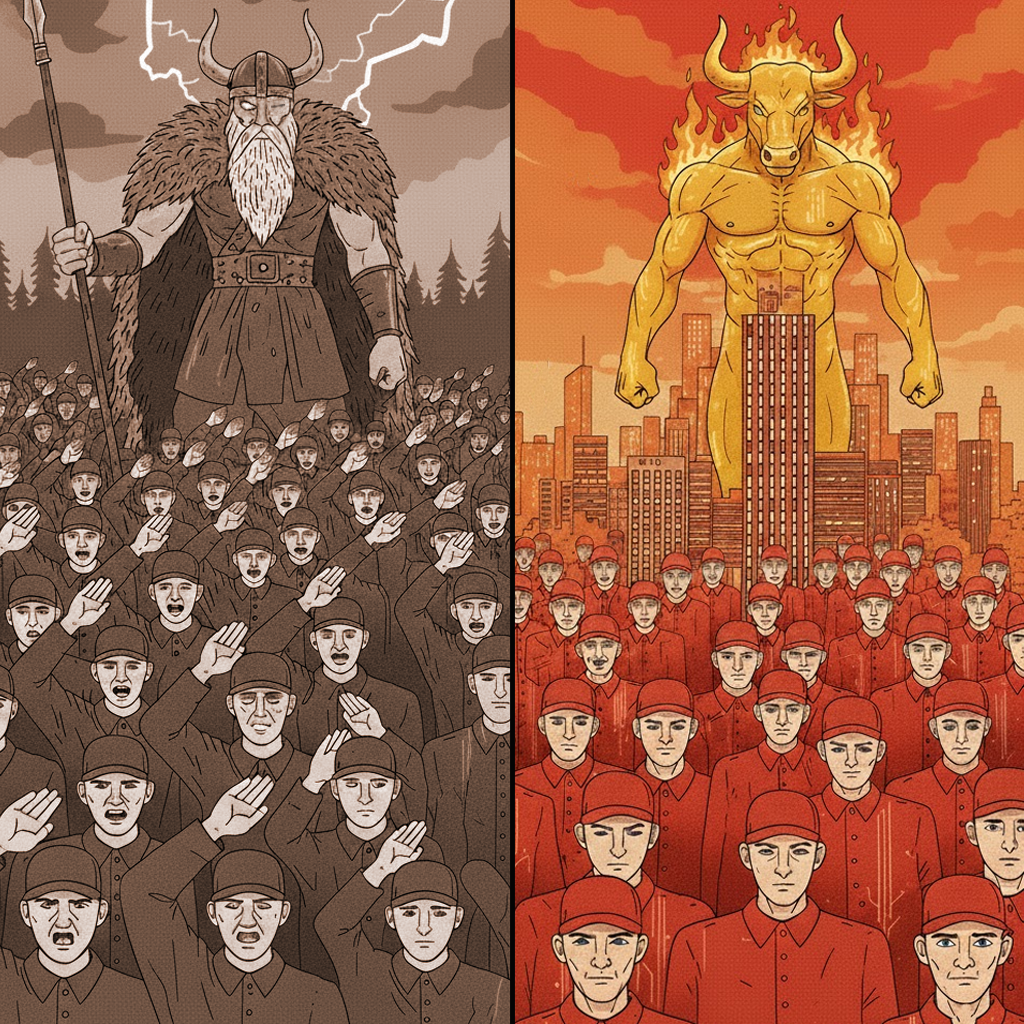
When we dehumanize another, we’re sacrificing our own humanity
When collective shadow eruptions occur, it’s rarely because of outright rage; more often it is righteousness. It’s the seductive, intoxicating conviction that we are ‘right.’ We are the conscious ones fighting for truth, and they are the unconscious carriers of darkness.
This high-mindedness is the most dangerous mechanism of the collective shadow’s syntonic relationship to our individual shadow, for it allows us to commit our worst acts of projection, separation, and even violence—all while wearing the mask of virtue.
The Most Insidious Trap: Righteousness as License
We are taught that fighting for a noble collective cause requires absolute certainty. We believe that to stand for justice, we must possess unassailable moral superiority. This impulse is genuine, but the resulting mental posture—moral certainty—becomes the shadow’s most effective hiding spot. It also becomes a powerful way for the collective shadow to spread.
Let’s be precise: the danger is not a firm moral stand, but the closed mental posture that justifies cruelty. We must distinguish between Moral Clarity and Moral Certainty.
- Moral Clarity is the necessary conviction that some actions are simply wrong (genocide, slavery, deliberate harm), providing the ethical center from which to act. Clarity drives us to protect and defend. It recognizes the inherent dignity of all people and is, therefore, always humble and open to the complexity of the world.
- Moral Certainty, by contrast, is the egoic fixation that I alone possess the unassailable truth. It quickly becomes a license to dismiss and dehumanize. Certainty closes the mind, refuses complexity, and justifies cruelty in the name of a higher good.
The sovereign individual must cultivate Moral Clarity—the grounded ethical center—while fiercely resisting the intoxicating trap of Moral Certainty that demands a psychological enemy for us to feel ‘right.’
Moral Certainty is the doorway for the collective shadow to exert influence upon the individual shadow because it justifies the necessary prerequisite for projection: the creation of a purely ‘good’ self and a purely ‘bad’ other. This is where the core Jungian mechanism is activated. The collective cause provides the perfect external screen onto which all individual shadow can be conveniently thrown.
The shadow is the disowned self: the parts we don’t want to admit are ours (our cruelty, our hypocrisy, our capacity for harm). When we find a collective cause we can champion, we are given a powerful psychological opportunity. We can use the cause to project all our unwanted darkness onto an external enemy. The collective shadow also takes advantage of this mechanism to spread from a individual to the collective.
This shift happens almost instantly. Consider someone encountering a social media post about environmental policy or parenting approaches—something they genuinely care about:
Initial Impulse (Authentic concern): “This is wrong. This approach could cause real harm.”
Shadow Response (Projection and performance): “Anyone who believes this is fundamentally ignorant/evil/dangerous/‘other.’ I must publicly expose how wrong they are so everyone can see my moral/ethical clarity.”
The internal focus on integration—What shadow is this activating in me? How can I contribute to actual solutions?—is immediately replaced by the external focus on condemnation: How publicly can I declare their failure?
The Slippery Slope to the ‘Other’
Once moral certainty takes hold, it triggers a psychological cascade that fundamentally undermines authentic engagement. Personal righteousness, no matter how justified it feels initially, inevitably demands the reduction of opponents to something less than fully human.
To remain pure and righteous, you cannot acknowledge that your adversary is a complex human being—a person with similar fears, motivations, and perhaps even their own genuine (if flawed) ethical concerns. To do so would complicate your moral purity.
Instead, the collective shadow demands that you:
Reduce Them to a Label: They cease to be individuals and become types—’woke,’ ‘bigots,’ ‘sheep,’ ‘extremists,’ even ‘democrats,’ or ‘republicans.’ This labeling is designed to dismiss the content of their humanity entirely.
Assign Malice: Their motivations are stripped of complexity and assumed to be purely malicious, selfish, or ignorant. Their actions are not the result of history or fear, but of innate badness.
Psychologically Expel Them: This is the point of dehumanization. The shadow requires a psychological boundary that makes the opponent disposable. They are no longer seen as fellow travelers on the human journey but as an infectious agent that must be quarantined or eliminated.
This act of othering is the ultimate form of shadow avoidance. It’s easier to see the totality of human cruelty embodied in an external enemy than to confront the small, uncomfortable capacity for that same cruelty within yourself.
At mass scale, this becomes toxic tribalism and profound divisiveness.
Othering as Mass Movement
History shows us that the collective shadow of superiority can escalate far beyond social media arguments and political polarization—it becomes part of the complex psychological foundation for many of humanity’s darkest and poignant chapters.
The mechanism is similar: a group convinced of its own moral, racial, or cultural superiority systematically strips another group of their humanity. The genocide of indigenous peoples across the Americas was justified by the ‘civilizing mission’—the righteous conviction that European culture was superior and indigenous ways of life were primitive obstacles to progress.
Slavery operated through elaborate philosophical, economic, social, and religious frameworks that positioned enslavers as benevolent caretakers of a supposedly inferior race.
Until the 1900s, women were reduced to property and considered intellectually and morally inferior, denied basic rights under the righteous belief that male guardianship was natural and protective. Women have only been voting since 1920.
The Holocaust represents perhaps the most systematic application of this psychology. The Nazi regime didn’t simply hate ‘the other’; they constructed an entire ideological framework that positioned themselves as the conscious guardians of racial purity, fighting against the unconscious carriers of civilizational decay.
Today, beyond just politics and social media, this same collective shadow operates in corporate boardrooms where executives—many of whom see themselves as ethical leaders—reduce human beings to ‘human resources’ (more accurately ‘humans=resources’) and ‘cost centers.’ Mass layoffs are framed as necessary economic measures, with employees becoming ‘other’; they’re labeled as ‘line items’ to be optimized rather than people with families, dreams, and dignity.
In each case, those who ‘other’ their fellow humans don’t see themselves as cruel. They often see themselves as righteous, necessary, even heroic. The collective shadow allows entire societies to commit gross atrocities and smaller scale marginalizations while maintaining their moral highground.
While we may no longer justify our superiority through claims of racial or cultural dominance—at least explicitly—the psychological mechanism remains unchanged. As society evolves and changes so does our collective shadow. It simply finds more sophisticated modes of expression.
When Consciousness Becomes Supremacy
This trap doesn’t just ensnare the ‘unconscious masses.’ It is perhaps most dangerous for those who consider themselves conscious, ‘evolved,’ or ‘awakened.’
Consider the shadow of ‘consciousness’—a powerful archetype in our digital age. This is the person who has done deep inner work and understands the concept of the shadow, yet uses that knowledge as a new source of superiority.
Picture someone who responds to political disagreement not with anger, but with a patronizing analysis: “This person clearly hasn’t done their shadow work. They’re just projecting their unintegrated trauma. I can see how unconscious they are.”
The judgment shifts from “You are wrong” to the much more corrosive “Your entire psychological/intellectual/social/cultural framework is inferior.”
They replace political tribalism with spiritual tribalism, creating a new in-group defined by who is ‘integrated’ and who is ‘unconscious.’ This new form of righteous judgment is simply the unintegrated ego wearing enlightenment as a mask. It is a profound failure of sovereignty, trading genuine, humble integration for a superior position on the new moral high-ground.
The Path of Shared Humanity
True eudaimonic sovereignty—the capacity to remain centered in your authentic flourishing—is defined by its refusal to participate in this descent. It requires a radical, defiant act of internal honesty: refusing to sacrifice shared humanity at the altar of moral certainty.
This commitment to shared humanity does not mean standing down in the face of actual injustice. To do so would be a profound moral failure. When we are faced with systemic oppression, racism, exploitation, or violence, the sovereign response cannot be pure psychological withdrawal.
True sovereignty demands that the work of internal integration be channeled into ethical action. The goal is not to stop fighting for justice; it is to fight without succumbing to the shadow’s demand that we first dehumanize our opponent. We can take a firm stand against unjust systems and harmful actions with moral clarity, while refusing to reduce the human beings who carry them out to purely malicious labels. This is the ultimate, non-superior form of conscious rebellion.
When you feel the urge to reduce another person to a label—to condemn them as fundamentally ‘other’—pause and go through this shadow hygiene self-check:
Is this energy integration or projection?
- What specific uncomfortable feeling is arising in me right now? Can I name it without immediately explaining it away? Am I more focused on changing them or understanding my own reaction?
Is my response generative or symbolic?
- If others weren’t watching, would I still take this action? Am I trying to solve a problem or demonstrate my position? What would happen if I responded privately instead of publicly?
Can I hold their humanity?
- What might drive someone to take this position? Can I imagine a scenario where a person I love might think this way? What would it feel like to genuinely want the best outcome for this person, even if they never changed their mind?
Additional questions to ask yourself:
The Certainty Check: How certain am I that I fully understand their position and motivations? Am I certain that it is true? Have I checked sources? (High unverified certainty often signals shadow activation)
The Energy Check: Does engaging with this give me energy or drain it? (Shadow projection often feels temporarily energizing but ultimately depleting)
The Time Check: How much mental time is this person/position/issue consuming? (Excessive preoccupation often indicates projection)
The Curiosity Check: Am I genuinely curious about why they think this, or do I already ‘know’ what’s wrong with them? (Lack of curiosity often indicates superiority)
The sovereign response isn’t about agreeing with them; it’s about seeing them. It’s about recognizing that authentic connection is the ultimate solvent for tribal conflict.
When you step out of the shadow’s demand for dehumanization, you create a space—no matter how small—where true dialogue might one day be possible. This choice to hold your center, and to hold the humanity of the ‘other,’ is the core of conscious rebellion.
It is the beginning of a world where superiority no longer casts its collective shadow over our shared humanity.