This is my own recounting of the story.
Original story, ‘The Nightingale,’ from Hans Christian Andersen, late 19th century.
First published in the United States by R. H. Russell, 1898.
Read at Project Gutenberg: https://www.gutenberg.org/ebooks/71096The analysis follows the story.
Long ago in ancient China, there lived an Emperor whose palace was the wonder of the world. Its walls were made of the finest porcelain, so luminous in the daylight that the palace rivaled the sun itself. In his gardens flowers grew so bountiful and enormous that silver bells could be hung from their stems, chiming whenever someone passed to ensure no one could ignore their splendor.
The gardens stretched so far that even the head gardener had never seen their end. Beyond the cultivated flowers lay a deep verdant forest that reached all the way to the sea, where fishing boats sailed beneath the overhanging branches. And in this wild forest lived a nightingale whose song was so pure and haunting that even the fishermen, tired from their long nights at sea, would stop their work just to listen.
“How beautiful,” they would whisper to themselves before returning to their nets.
Travelers came from every corner of the earth to see the Emperor’s magnificent palace and gardens. They wrote books and poems about the wonders they had witnessed. But in every account, the same refrain appeared: “Beauty abounds, yet the nightingale’s song surpasses all other marvels.”
When the Emperor read these words in a book sent to him by the Emperor of Japan, he was astonished. “A nightingale? In my own domain? How is it possible that I know nothing of this creature that the world considers my greatest treasure? How can something I did not create surpass what I’ve built?”
He summoned his chief minister, a man so pompous that he would only respond with “Hmph!” to anyone beneath his station.
“Find this nightingale immediately,” the Emperor commanded. “It must sing for me tonight, or the entire court will face my wrath.”
The minister searched high and low but found no one at court who had ever heard of such a bird. Just as he was about to report his failure, a young kitchen servant spoke up.
“The nightingale? Oh yes, I know it well. Every evening when I carry scraps to my sick mother who lives by the shore, I rest in the forest on my way back. That’s when I hear the nightingale sing, and it’s so beautiful that tears come to my eyes, as if my mother were singing me a lullaby.”
So the girl led half the court into the forest. Along the way, they mistook a cow’s lowing for the nightingale’s song, then the croaking of frogs. But finally, they heard it—a silver thread of melody weaving through the trees. This sweet song of truth and beauty led them to a small clearing.
“There!” the girl pointed to a small, plain gray bird perched on a branch.
The courtiers were shocked by the bird’s ordinary, even humble appearance, but when it sang for them, even the most jaded among them were moved to tears. The nightingale agreed to come to the palace, though it said wistfully, “My song is the song of the green wood; I know not how it will sound in the halls of the palace.”
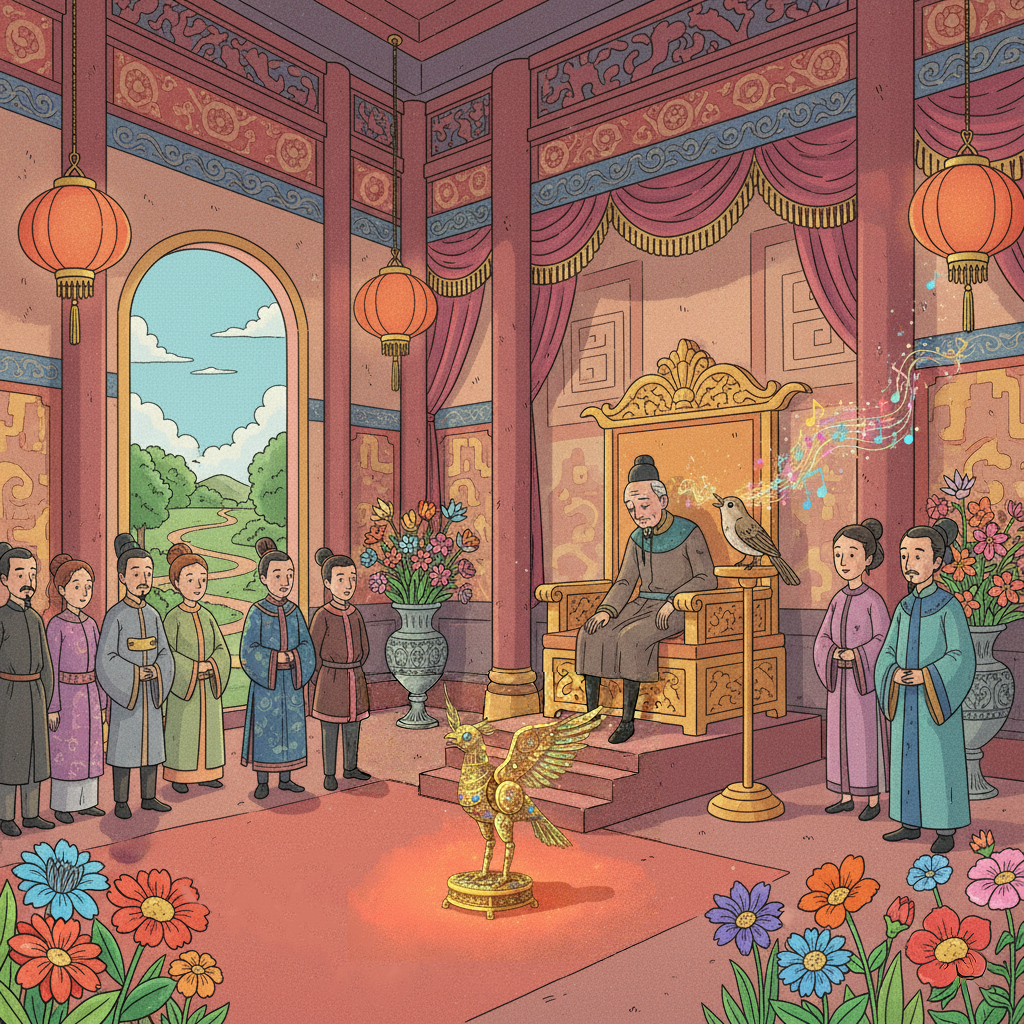
That night, the palace blazed with golden light. The porcelain walls reflected thousands of lanterns, and the air shimmered with the sound of silver bells. On a golden perch in the center of the great hall sat the little gray nightingale.
“This cannot be the nightingale,” the Emperor remarked. “This ordinary gray bird. This cannot be the singer of a song greater than my own marvels.”
“Sing bird!”
When it sang, the Emperor wept openly. The song seemed to reach into his very soul and draw out feelings he had forgotten he possessed. He offered the bird his golden slipper as a reward, but the nightingale declined.
“Your tears are treasure enough for me,” it said. “An emperor’s tears have special power—they show that beneath the crown beats a human heart.”
The nightingale was given a golden cage and twelve servants to attend it, with silk ribbons tied to its legs whenever it went out. The whole city spoke of nothing else, and merchants named their children after the famous bird.
A few weeks later a package arrived from the Emperor of Japan. Inside was an artificial nightingale, crafted from gold and encrusted with diamonds, rubies, and sapphires. When wound up, it could sing one song perfectly, its jeweled tail moving up and down in precise rhythm.
The court was enchanted by this mechanical marvel. Unlike the real bird, it sang the same song flawlessly every time. There were no surprises, no variations—just predictable beauty that could be controlled and understood.
“Much better than the real thing,” declared the court musician. “With this bird, we always know exactly what we’ll get.”
The Emperor, swayed by the letter from the Emperor of Japan and the gossip in his own court, decided to have the two nightingales sing together so he could judge for himself which nightingale was truly superior.
During the performance the Emperor was captivated by the gleaming jewels of the wind-up bird. He was lulled by its song… the song he’d heard over and over… it was indeed, very predictable.
The real nightingale sang a song the Emperor and his court had never heard. The song was filled with the stories of the common people from across the empire: the fishermen, the market workers, and the servants.
The Emperor was taken aback. A song, of commoners, in his court, from his own nightingale. In shock, he demanded that the real nightingale cease its song at once. “The real nightingale is hereby banished!” decreed the Emperor. “This bejeweled bird is far more beautiful. I always know the song I’ll get from this mechanical bird. Its song is perfect every time. No surprises. No unpredictable behaviors that one has to deal with from a living creature.”
For a year, the mechanical nightingale entertained the court with its single song. Everyone learned it by heart and sang along. But one evening, as it performed for the Emperor’s bedtime ritual, something inside it went “crack!” The gears ground to a halt, and the music died.
The court clockmaker managed a temporary repair, but warned that the bird was too delicate for frequent use. It could sing only once a year, and even that might be too much.
Five years passed. The Emperor fell gravely ill, so ill that a new ruler had already been chosen. He lay in his bed, barely able to breathe, feeling as though a great weight pressed upon his chest.
In his fevered state, he saw Death itself sitting on his chest, wearing his golden crown and holding his sword and banner. Around the bed, ghostly figures whispered accusations—all the cruel deeds and selfish choices of his reign rising up to torment him.
“Music!” he gasped, looking at the silent artificial bird. “Please, sing to drown out their voices!” But no one was there to wind it up.
Then, through the window, came the purest sound he had ever heard. The real nightingale had returned and sat on a branch outside, singing with all its heart.
As the bird sang, the ghostly figures faded away. Death himself was so moved by the music that he began to weep, and with each tear he released his hold on the crown, the sword, and the banner. Finally, Death himself dissolved like morning mist and floated away through the window.
“Thank you,” whispered the Emperor. “I banished you, yet you saved my life. How can I ever repay such kindness?”
“You have already repaid me,” the nightingale replied. “Your tears when I first sang were worth more than any treasure. Now you may sleep peacefully.”
The Emperor slept deeply and woke refreshed and healed. His servants, who had given him up for dead, found him sitting up in bed, very much alive.
“Stay with me always,” the Emperor begged the nightingale.
But the bird shook its head gently. “I cannot live in a cage, even a golden one. But I will come whenever you need me. I will be your eyes and ears in the world beyond these walls, bringing you songs of your people’s joys and sorrows. I will sing the truth of your people to you. But promise me this: you must listen with your heart when I sing to you and you must tell no one that I am your ears and eyes.”
The Emperor agreed, and the nightingale flew away into the dawn. From that day forward, he ruled with greater wisdom and compassion, always listening for the small, true voice that would come to him through his window when he needed it most.
And in the forest by the sea, the fishermen still pause in their work when they hear a certain song drifting through the trees, knowing they are blessed to witness something that no amount of gold could buy.
The Emperor and the Nightingale: What A Fairy Tale Tells Us About Our Relationship to AI
In this Hans Christian Andersen tale, The Nightingale, an emperor becomes so enchanted with an artificial, jewel-encrusted mechanical bird that he banishes the real nightingale from his court. The fake bird dazzles everyone with its predictable performance and glittering exterior, while the authentic nightingale—with its infinite repertoire responding to life’s deepest emotions—is sent away. Only when the mechanical bird breaks down and the emperor faces Death does the real nightingale return, not with resentment, but with the life-saving song his soul desperately needs.
Nearly two centuries later, this story offers a perspective on our current AI conundrum.
The Allure of the Artificial
Like the emperor’s court, we’ve become mesmerized by our own mechanical nightingales. AI chatbots that produce polished prose on demand. Image generators that create stunning visuals in seconds. Tools that promise to automate creativity, decision-making, even human connection. They’re novel, shiny, impressive, and remarkably consistent—much like that bejeweled bird that could sing the same tune perfectly every time.
But here’s what the fairy tale reveals about our current moment: the emperor, in spite of his reaction to the bird’s plain appearance, did not reject the song when the nightingale sang for him. He wept openly—”the song seemed to reach into his very soul and draw out feelings he had forgotten he possessed.” The bird’s ordinary gray appearance couldn’t diminish the power of its authentic song.
The tragedy isn’t that the artificial bird was beautiful. The tragedy is that the court—and the emperor—convinced themselves it was “much better than the real thing” simply because it was predictable and controllable.
The Comfort of the Mechanical
What made the mechanical nightingale so seductive wasn’t just its jeweled exterior—it was its reliability. Wind it up, and you knew exactly what you’d get. No surprises, no variations, no need to listen with your heart. As the court musician declared, “With this bird, we always know exactly what we’ll get.”
In our efficiency-obsessed culture, this sounds remarkably familiar. We’re drawn to AI for similar reasons. Why struggle with the uncertainty of human creativity when algorithms promise consistent output? Why engage in the slow, sometimes frustrating process of authentic human connection when chatbots offer predictable responses?
The mechanical nightingale of AI promises to eliminate the friction of human unpredictability. But as Andersen shows us, that unpredictability—that ability to sing exactly what the moment requires—is often what saves us.
The Uncomfortable Truth
But there’s something deeper happening in the emperor’s choice that reveals an even more troubling pattern. When the two birds perform together, the real nightingale doesn’t just sing differently—it sings dangerously. It brings “the stories of the common people from across the empire: the fishermen, the market workers, and the servants” directly into the imperial court.
The emperor’s reaction is telling: he’s “taken aback.” Not disappointed by inferior performance, but shocked by the content itself. “A song, of commoners, in his court, from his own nightingale.” This is what triggers the banishment—not a preference for beauty, but a rejection of uncomfortable truth.
The mechanical nightingale offers something more seductive than mere predictability: it offers complicity. It will never challenge the emperor with perspectives from beyond his porcelain walls. It will never force him to confront the reality of his subjects’ lives. Wind it up, and it sings exactly what he wants to hear, exactly how he wants to hear it.
What We Lose When We Choose the Artificial
In the fairy tale, the real nightingale doesn’t abandon the emperor out of spite when he chooses the mechanical bird. It simply “quietly flew out an open window and back to its forest home. No one noticed until it was too late.” This detail is crucial: authentic human capabilities don’t disappear with a dramatic exit. They slip away quietly while we’re distracted by shinier alternatives.
The real nightingale possesses something the artificial one never could: the ability to respond to genuine need. When Death sits on the emperor’s chest and ghostly accusations torment him, the mechanical bird sits silent—beautiful but useless. The real nightingale returns not with the same predictable song, but with exactly what’s needed to save a life.
Human creativity and intelligence work the same way. They respond to context, read emotional subtleties, make unexpected connections that surprise even ourselves. When we become too dependent on our mechanical nightingales, we risk losing these irreplaceable capabilities—not through dramatic failure, but through quiet atrophy.
The Grace of the Authentic
Perhaps the most profound aspect of Andersen’s tale is the nightingale’s response to being banished. When the emperor begs it to stay after being saved, the bird doesn’t demand apologies or acknowledgment of past wrongs. Instead, it offers something more valuable: “I will be your eyes and ears in the world beyond these walls, bringing you songs of your people’s joys and sorrows.”
This is what authentic human intelligence offers that artificial intelligence cannot: not just information processing, but wisdom born from genuine connection to the world and its deeper truths. The nightingale promises to “sing the truth of your people” to the emperor—something no mechanical bird, however sophisticated, could ever do.
The Song That Saves
In the end, what saves the emperor isn’t the mechanical bird’s perfect performance, but the real nightingale’s ability to sing exactly what his soul needs to hear. It’s the difference between optimization and wisdom, between processing and understanding, between artificial intelligence and authentic human insight responding to the moment’s deepest needs.
The nightingale’s song doesn’t just entertain Death—it moves him to tears, causing him to release his hold on the emperor’s life. This is the power of authenticity: it can transform even Death itself.
Learning to Differentiate
The fairy tale’s ending offers us a model for navigating our AI moment. The emperor doesn’t destroy the mechanical bird when the real nightingale returns—it simply goes back to being what it always was: a beautiful object, useful in its place, but not a replacement for authentic life and connection.
The real nightingale establishes a new relationship with the emperor: “I will come whenever you need me.” Not as a caged possession to be controlled, but as an authentic presence that appears when genuine need calls.
This suggests a path forward with AI: appreciating these tools for what they offer while maintaining space for the irreplaceable magic of human creativity, intuition, and genuine connection. We can listen to the mechanical nightingale’s one song, while recognizing it is nothing more than a tool.
The real nightingale never stopped existing. It was simply waiting in the forest by the sea, where “fishermen still pause in their work when they hear a certain song drifting through the trees, knowing they are blessed to witness something that no amount of gold could buy.”
Our task isn’t choosing between the mechanical and the real, but learning—like the transformed emperor—to listen with our hearts and differentiate between the authentic song of wisdom and humanity and repetitive collection of the sounds of data and information when we hear it.