This is my own recounting of a Lucumi pataki (story). Oba Bi told me this pataki in Havana, Cuba, in 1999.
The analysis follows the story.
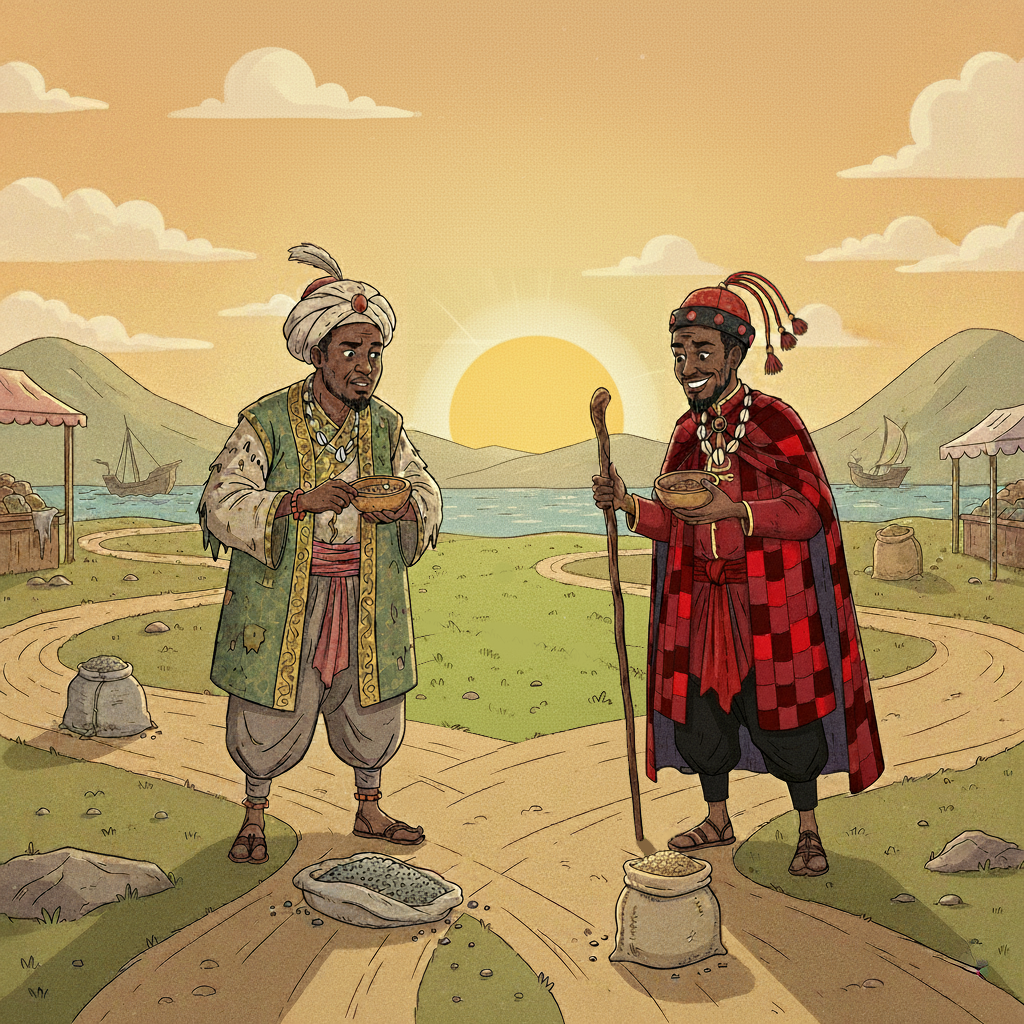
A merchant found himself at the crossroads, both literally and figuratively. Business had been rough, competition was fierce, and his usual instincts seemed to fail him. He’d heard stories about Ellegua—the orisha who opens paths, who knew things humans didn’t. So he brought his best palm wine and kolanuts to the crossroads to make his case.
“I need an advantage,” he told Ellegua. “Something to cut through all this uncertainty.”
Ellegua, who had heard variations of this request for centuries. Ellegua grinned and produced a small calabash. “This will give you what you’re looking for,” he said. “Ask it any business question. Shake it. Listen. But remember—your own head matters too. You must listen with your own head too.”
The merchant was filled with excitement. This was it. His competitive advantage. His secret weapon. He had Ellegua’s wondrous calabash!
Back home that evening, he posed his first question: “What goods should I invest in?” He shook the calabash. The sound of seeds rattling inside seemed to whisper “textiles.” He bought textiles. They sold, all in one day.
“Which port should I visit next?” Shake, rattle. “Lagos,” obviously. He sailed to Lagos and returned with profits that made his competitors green with envy.
For weeks, it was magical. The calabash seemed to know everything—which goods to buy, which routes to avoid, which partnerships to pursue. The merchant stopped paying attention to the market; ignored his competitors; he even stopped listening to his village. Why bother studying trade winds or political tensions when you had magic? He stopped thinking about strategy… or anything else… altogether.
“I have Ellegua’s wondrous calabash,” he’d boast to anyone who would listen. “I don’t need to spend time analyzing anything anymore. It’s a waste of time… all I have to do is shake my calabash.”
But, slowly, the magic started to feel… off. The messages stopped making sense. The calabash told him to buy grain, so he did, in massive quantities. He hadn’t heard the other merchants talking about the unbelievable growing season and the bountiful harvests all over the land. He couldn’t sell the grain, so it spoiled.
He tried again. The calabash sent him to a supposedly profitable port that turned out to be closed for repairs, leaving him stranded with a full cargo hold and mounting costs. Had he listened to the talk in the village, he’d have known.
One by one, his ventures failed. Ships lost, cargo ruined, partnerships dissolved. Within months, he was going broke. Even worse off than before.
One afternoon he stormed back to the crossroads, calabash in hand, fury in his heart.
“Your magic failed me!” he shouted at Ellegua. “Everything has gone wrong!” Ellegua appeared, unsurprised. “Show me the calabash.”
The merchant thrust it forward. “It stopped working! Your power abandoned me!” “Open it,” Ellegua remarked, with a sly grin, unmoved.
Inside: just dried seeds. Nothing magical. Nothing divine. Just… seeds. “But the voices… the guidance…”
Ellegua’s expression shifted from amusement to something more serious. “When you first came to me, you were still watching the world, still thinking, still listening to your own head, still bringing your experience to bear on decisions. The rattling didn’t tell you anything—it helped you listen to what you already knew in your own head. Your wisdom was working in partnership with possibility.”
The merchant stared at the ordinary seeds.
“But when you stopped thinking, when you decided the calabash should do your head’s work for you, what do you think happened to your judgment? When you stopped observing, stopped learning, stopped engaging with reality—what was left to guide you?”
The truth hit him like a physical blow. All those successful early decisions hadn’t come from the calabash at all. They’d come from his own accumulated knowledge, his years of experience, his conversations with others, his instincts—amplified by the confidence that came from feeling supported by external magic.
“I open paths,” Ellegua said, “but I don’t walk them for you. I expand possibilities, but I don’t eliminate the need for wisdom. Your own head has more say in your destiny than I do. The moment you stopped participating in your own success, you stopped succeeding.”
As Ellegua turned to walk away, he left the merchant with a final thought:
“The calabash was never magic. Your thinking was. Your own head is the magic, but magic that isn’t used atrophies. Magic that isn’t practiced disappears. The crossroads I govern aren’t just physical spaces—they’re the points between decisions; the spaces in between. And every decision requires you to show up with your full capacity and act with your own head using your own intuition, not just your expectations.”
The Wondrous Calabash: What Happens When You Outsource Your Thinking
In the accelerating current of our digital age, powerful AI tools promise to cut through uncertainty, optimize decisions, and amplify our capabilities. They whisper of a future where complex problems are solved with a simple prompt, and intuition is replaced by algorithm. But what if, in our eagerness to embrace this new magic, we lose something far more valuable: our own capacity to think?
This is the timeless warning embedded in the Yoruba folktale of Ellegua’s Magic Calabash, a narrative that serves as a potent allegory for the dangers of cognitive atrophy in the era of Artificial Intelligence. It adds a crucial dimension to the discussions we’ve had about the character of the wielder (Legba’s Stick) and the value of authenticity (The Nightingale), by focusing on the atrophy of our own judgment when we outsource our thinking.
The Crossroads of Choice
Our story begins with a struggling merchant, desperate for an advantage. At the crossroads, he encounters Ellegua, the Orisha who opens paths. Ellegua, sensing the merchant’s longing for clarity, offers a small calabash. “Ask it any business question. Shake it. Listen. But remember—your own head matters too. You must listen with your own head too.”
This initial guidance is critical. The calabash is not a replacement for thought, but a partner. In the beginning, the merchant flourishes. When the calabash whispers “textiles” or “Lagos,” it’s not giving him entirely new information; it’s amplifying his existing, accumulated knowledge and instincts. It’s the confidence derived from the calabash that helps him trust his own well-honed intuition. His wisdom works in partnership with possibility.
The amplification of confidence, however, masks a fundamental and often overlooked danger for the non-expert user: the problem of the confident error. When AI generates an answer, it is so ‘certain’ and well-spoken—grammatically flawless and contextually fluent—that this unwavering delivery acts as an intellectual bludgeon. For the merchant sleepwalking through his trade, or any novice in the digital age, this confident presentation is indistinguishable from actual knowledge. Without the foundational expertise or social engagement needed to spot a subtle flaw, the user is compelled to simply adopt the error as a core truth, allowing the AI’s eloquence to replace critical thought with misinformation disguised as authority. This immediate trust in the certainty of the source—rather than in their own mind—is what sets the stage for the merchant’s later downfall.
The Seduction of Passive Reliance
The turning point, however, arrives with prosperity. Intoxicated by easy success, the merchant falls prey to a common human failing: intellectual laziness. He stops studying trade winds, ignores political tensions, and dismisses the insights of his village. “I don’t need to spend time analyzing anymore,” he boasts. “It’s a waste of time… all I have to do is shake my calabash.”
This is where the allegory resonates most deeply with our relationship to AI. We see powerful AI models—language models, recommendation engines, predictive analytics—and begin to believe they possess independent intelligence. We rely on them to:
- Summarize complex documents without reading the originals and without engaging with the source material ourselves.
- Generate strategies without understanding the market context.
- Recommend choices without engaging with the underlying nuances.
We move from using AI as a tool to augment our thinking to allowing it to replace our thinking entirely.
The Bitter Harvest of Atrophy
The merchant’s inevitable downfall mirrors the consequences of this cognitive outsourcing. The calabash advises him to buy grain, but he fails to observe the market’s real conditions of bountiful harvests “…all across the land.” It sends him to a port that, unbeknownst to him, because he stopped listening to his village, is closed for repairs. His ventures fail, one by one.
The devastating truth reveals itself when Ellegua prompts him to open the calabash: it contains nothing but dried seeds. No magic. No divine insight.
Ellegua’s words deliver the crushing blow: “When you stopped thinking, when you decided the calabash should do your cognitive work for you, what do you think happened to your judgment? When you stopped observing, stopped learning, stopped engaging with reality—what was left to guide you?”
The magic wasn’t in the seeds; it was in the merchant’s active, engaged mind. The calabash merely reflected back what he already knew, amplified by confidence. When he stopped replenishing his wellspring of knowledge and experience, the “magic” had nothing left to draw from, nothing to amplify. His cognitive muscle had atrophied.
AI and the Danger of the Dormant Mind
In our rush to embrace AI, we face a similar risk. If we delegate too much of our critical thinking, observation, and judgment to algorithms, we risk making our own mental faculties dormant.
- When AI generates content, do we still cultivate our creativity?
- When AI optimizes decisions, do we still hone our strategic thinking?
- When AI filters information, do we still engage in direct observation and critical analysis?
Ellegua’s final words are a stark reminder: “…The crossroads I govern aren’t just physical spaces—they’re the points between decisions; the spaces in between. And every decision requires you to show up with your full capacity and act with your own head using your own intuition, not just your expectations.”
The true power of AI lies not in its ability to think for us, but in its potential to empower us to think better, more creatively, and more deeply. But only if we resist the urge of outsourcing our own minds. The magic was never in the calabash; it’s in our own, actively engaged consciousness. And like any magic, it atrophies if it isn’t used, practiced, and cherished.